Timeline of the Development of the Horse
by
Beverley Davis
Except possibly for the dog, no animal has contributed more to humanity than the horse. It has fed and sheltered us, and provided us with clothing and transportation; it has been both worshipped as a god and slaughtered to appease the gods. No one could write the entire history of the horse, but the facts gathered here may make it easier to understand horses and the importance they once had for us.
Beverley Davis
Glossary
* indicates an imported breed.
- ApHC:
- Appaloosa Horse Club
- AQHA:
- American Quarterhorse Association
- BCE:
- Before the Common Era
- BLM:
- Bureau of Land Management (U.S. Department of the Interior)
- Carousel:
- A riding extravaganza at the French court; gave its name to the fairground ride
- Cataphract:
- A heavily-armored cavalryman
- CE:
- In the Common Era
- Glaciation:
- A period when glaciers were on the land
- Hand:
- Unit of measure for the height of a horse: four inches
- mtDNA:
- Mitochondrial DNA
- MYA:
- Million years ago
- NCO:
- Non-commissioned Officer
- Overo:
- A type of spotted horse characterized by having no white across the back (See tobiano)
- Petrogylph:
- Rock art created by incising, pecking, carving, and abrading the rock surface
- ProtoArab:
- Any one of a number of ancient breeds that contributed to the development of the Arabian horse
- QH:
- Quarterhorse
- Red corn:
- A roan horse with appaloosa markings
- Remount:
- A horse requisitioned for the U.S. Army
- Sabino:
- A type of pinto horse, often roan-based
- Scalae:
- Predecessors of stirrups
- SMR:
- Spanish Mustang Registry
- Taki:
- Mongolian name for the 66-chromosome horse
- Tobiano:
- A type of spotted horse characterized by having white across the back (See overo)
- Tovero:
- A horse that is half overo, half tobiano (See overo, tobiano)
- TWHBEA:
- Tennessee Walking Horse Breed registry designator
Timeline of the Development of the Horse
Years Before the Common Era

Stratus Map for the Evolution of the Horse courtesy of Dr. Bruce MacFadden, University of Florida
75 million BCE
- The dog-sized, five-toed Condylarth inhabits early Eocene forests.
55 million BCE
- Hyracotherium, also known as Eohippus (dawn horse), has four toes.
![eohippus_PragueCh[1]](horses/image003.jpg)
Eohippus from Prague, Czechoslovakia
53 million BCE
- Orohippus coexists with Hyracotherium but is not as numerous.
37–32 million BCE
- Mesohippus lives in Colorado and the Great Plains of the United States, in the Oligocene Age.
32–25 million BCE
- Miohippus gives rise to numerous species of equids.
24–19 million BCE
- Kalobatippus, a long-legged browser, lives in the western U.S.
24–17 million BCE
- Parahippus, a three-toed link between browsers and grazers, is the size of a German shepherd and lives in the Great Plains and Florida.
21–13 million BCE
- Archaeohippus, a collie-sized browser, whose remains have been found in Nebraska, Oregon, California, and Florida, lives.
17–11 million BCE
- Hypohippus is a pony-sized browser, whose remains have been found in Nebraska, Colorado, and Montana.
- Merychippus, first known browser and a three-toed ancestor of modern horses, lives in the Miocene Age.
16–5 million BCE
- The most successful hipparion horse, the three-toed Neohipparion, lives in North and South America.
15–11 million BCE
- Megahippus, the last of the browsing, three-toed horses in America, is, for its time, quite large, weighing as much as 600 pounds.
- Nannipus is smaller than its ancestor; its remains were found in Florida.
13–5 million BCE
- Dinohippus, the powerful horse, the closest relative to Equus, lives.
12–6 million BCE
- Pliohippus thrives on the Great Plains and in Canada. It evolves into the Plesippus.
10 million BCE
- A volcanic eruption in Nebraska kills hundreds of Miocene Age horses, camels, rhinos, and birds.
5 million BCE
- Equus appears and continues to the present.
- mtDNA research shows that the various families of Equus split off in the following order: mountain zebra (E. hippotigris) first, then the asses, the Damara and Grant zebras, the Grevy zebras (Dolichohippus), the hemiones, and, lastly, the horse, E. Caballus and Przewalski. Plains zebras are E. burchelli and E. quagga.
2 million BCE
- The Pleistocene Age takes place.
- The last of the hipparions, Cormohipparion emsliei, becomes extinct.
- Hippidion lives in South America until 10,000 BCE. This equid was the size of a Clydesdale and may have had a flexible nose.
- Equis livenzovensis, with large, not very involved upper teeth and slender bones, enters Europe. (E. stenonis, the oldest species of true horse, which evolved from Plesippus, arrives later. Equus scotti was its North American counterpart.)
- E. sanmeniensis, E. sivalensis, and E. namadius enter Asia.
- E. koobiforensis enters Africa.
- E. sussenbornensis arrives in Europe late in the Pleistocene Age, at the same time as E. altidens. Sussenbornensis is the largest equid in Europe and seems to be adapted to open environments.
- E. giganteus, which is the size of the modern Quarterhorse, is the largest Pleistocene horse in North America at this time.
1.5 million BCE
- E. stehlini, a wild ass, lives in Italy.
1 million BCE
- The ass and the onager separate.
650,000 BCE
- A super volcanic eruption in Wyoming creates the Wyoming caldera and Yellowstone; the climatic changes are devastating.
200,000 BCE
- The Yukon horse (Equus lambei), 12 hands high and similar to the Przewalski horse, is a common ungulate in parts of Alaska, the Yukon, and the Northwest Territory.
- A similar species of small wild horse, Equus caballus lenensis, lives in the unglaciated regions of Siberia.
- Equus complicatus (so named because of its teeth) is the most common horse in the eastern and southern U.S.
- Equus mexicanus, a type of onager, is common in North America.
136,000 BCE
- Equids leave North America for Asia, while Bison priscus enters North American, by the Berengia Land Bridge.
74,000 BCE
- Super volcanic eruption of Toba in Sumatra leads to a major ecological catastrophe, threatening even the human population with extinction.
40,000 BCE
- Cave art in France and Spain depicts the Taki, ancestors of the Sorraia.

Lascaux Horse
32,000–12,000 BCE
- An estimated 30,000 horses are killed during this time period at one site in Europe. This does not include the remains at other sites.
18,000–16,500 BCE
- Paintings of a big-bellied horse, a bust of a horse, and engraved horses exist in Cosquer Cave, France.

Ivory Horse Head
16,000–15,000 BCE
- Remarkable paintings of horses and other animals are made at Peche-Merle Cave, France, including two horses with spots, which were long thought to be representations of leopards until Alexander Marshak, using infrared photography, showed them to have been created over hundreds, perhaps thousands, of years.
- Rising temperatures in the northern hemisphere cause glacial melting that leads to widespread flooding, as the oceans rise 120–130 feet worldwide.

The horses of Peche-Merle
12,000 BCE
- The Yukon horse, E. lambei, becomes extinct.
10,000 BCE
- Hunters in Alberta, Canada (St. Mary’s Reservoir), butcher horses for food. Equus conversidens, also called the Mexican horse, coexists with the larger Equus occidentalis. Some think that the Mexican horse is an onager.
8000 BCE
- The city of Jericho is founded, the oldest human settlement on earth. Cattle, sheep, and goats, but no horses or asses were present.
6000–4000 BCE
- The horse is domesticated in southern Russia. The first horsemen are the Indo-Iranians and Celts. Archaeological evidence indicates that the first bits were made of wood.
5960 BCE
- Mt. Vesuvius erupts, one of the largest eruptions in European history. (Could it be that the resulting climatic change allowed the steppe peoples to save the horse from extinction?)
- North Africa at this time has abundant water and rainfall. Prior to the eruption it was two degrees warmer than currently. Wild asses and zebras are present.
5700 BCE
- Mt. Mazama erupts in the U.S., and Crater Lake is created. The resulting ashfield extends from New Mexico to Alberta, causing a major disruption of the ecosystem.
3000 BCE
- Petroglyphs found in Armenia (one of the possible sites for the Indo-European homeland) show the oldest pictures of men driving chariots, wagons, and plows, with horses doing the pulling.
- The wild ass is domesticated in Africa.
- The Nile floods start diminishing.
- The European wild ass, Equus hidruntinus, becomes extinct.
2675–2565 BCE
- Tombs from the Fourth Dynasty in Egypt show that large herds of donkeys were being kept by wealthy people. A pharaoh is entombed with six.
2500 BCE
- The Sumerians of Ur use onagers, controlled with nose rings that often leave them bloody, to pull heavy chariots.
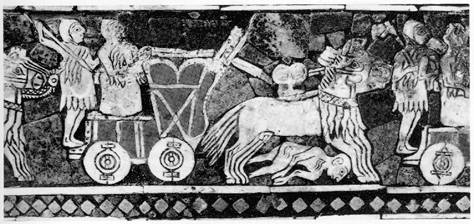
Royal Standard of Ur
2000 BCE
- Celts enter Europe with their small, gaited horses; bays and tobianos are common. Their goddess is Epona, who gives her name to the word “pony.” Austurcons, Galacians, and Garranos are descendants of the Celtic pony. (DNA testing has confirmed relationships between the breeds, as well as a relationship between the Sorraia, Konik, and the recreated Tarpan.)
- Primitive wagons dating from this time have been found in excellent condition in Armenia. These are the oldest known wagons in the world.
- The Elamites first mention a horse people called the Kassites.
- The European wild horse is almost extinct.
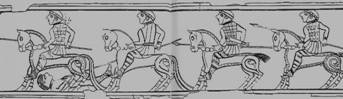
Celtic Horsemen in Art
1900–1800 BCE
- Indo-European horsemen arrive in Asia Minor. King Anittas of the Hittites follows and sacks the cities of the indigenous people, including Hattusas, an important Hatti city. Prior to this time there were no domestic horses in Asia Minor, the Middle East, or Africa.
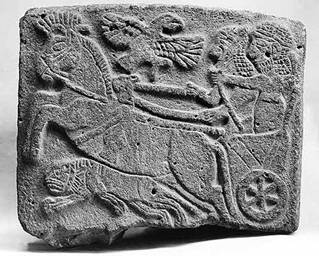
Hittite chariot team from Metropolitan Museum of Art
1800 BCE
- Damascus, Syria, is the center of the trade in donkeys. Large, white riding donkeys and gently gaited donkeys for women are two of the types sold here.
1759 BCE
- The Hyksos, believed to be from the Phoenician city of Ashkelon (also spelled Ashqelon, classical Ascalon or Askalon), a city on the coastal plain of Palestine, invade and conquer Egypt, introducing the horse and wheel. These are the first horses to enter Africa. They are probably of the Hittite strain, based on the politics and alliances of that time.
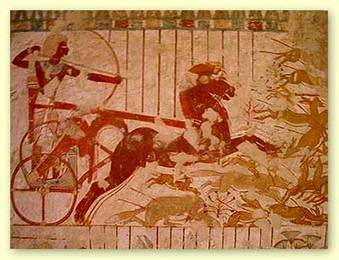
Userhat hunting with red and white chariot horses
1750 BCE
- The Hittite Old Kingdom is founded by Hattusilis I, and Hattusas is his capital. Hittite horses rank among the first horses in the Middle East. Artwork shows that they belong to the same family of horses that gives rise to the Arabian.
1700 BCE
- Gandash is king of the Hittites, with his capital at Dur Kurigalzu.
1650 BCE
- The Minoan island of Thera (Santorini) erupts, the greatest volcanic eruption in the last 10,000 years. Tsunami waves of 100 feet in height cross the Mediterranean. Minoan art shows that their horses were elegant animals.

Horse effigy from ancient Armenia
1620–1590 BCE
- Hittites and Kassites are allies during the reign of Hittite king Murcilis, a man bent on conquering as much land as possible. Babylon falls to him, but he leaves it in the hands of the Kassites, who introduce the first horses into Babylon.
1500 BCE
- The Mittani arrive in the Middle East and ally with Egypt; Wassukkani is their capital. The famous black horses of Nefertiti were probably Mittani.
- Horses are introduced into northern India at this time, the beginning of the Vedic Era. Mittani and Indian horses belong to the same family.
- Sometime between 1500 and 1450, King Shaushshatar of the Mittani loots the Assyrian city of Ashur, teaching its citizens the importance of the horse.
1415 BCE
- Menna, an official of Thutmose IV, has pictures of his red overo chariot horses painted on the wall of his tomb.
1400 BCE
- Celts enter northern Spain with the domestic horse.
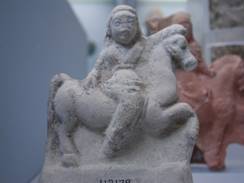
Epona, Celtic Horse goddess courtesy of Chris Hopkins, Parthia.com
1360 BCE
- After the death of Tushratta, last king of the Mittani, a war of succession leads to the Mittani becoming a part of the Hittite Empire. Mittani and Hittite horses are crossed to produce a superior horse suitable for war, chariot pulling, and racing.
1350 BCE
- Kikulli of the Mittani writes the first book, in cuneiform, on the care and feeding of chariot horses.
1318–1304 BCE
- Seti I defeats the horseless Libyans (Berbers) at Karnak. His horses are depicted, when painted on walls, as a deep sorrel color, very Arabianesque.
1307–1275 BCE
- Adad nirari I makes the lands of the Mittani horse a part of the Assyrian Empire. Assyrian art shows that these horses were very like Arabians.
1300 BCE
- Metal bits are now in use.
1286 BCE
- Hittites defeat Ramses II at Kadesh in Syria, using 3,500 chariots.

King Tut chariot horses similar to the ones Ramses used
1200 BCE
- Hattutas, the Hittite capital, is sacked and burned by “sea peoples,” probably Greeks. The era of the Hittite chariot horse is coming to an end.
1200–900 BCE
- The Celtic people arrive in Great Britain.
- Horsemen arrive in China. Legendary Emperor Mu has a shaggy black horse that looks like a dog and runs away whenever people come near. The Chinese word for horse, ma, appears to be related to the English “mare,” the Irish mark (horseman), and Persian maal (workhorse).
- The Latini migrate to Italy from the Danube region; they have their own horses.
1170 BCE
- The Kassites disappear as a world power. In Persian times they raise great horses for the Shah of Persia and have dealings with Alexander III. The Elamites drive them into the Zagros Mountains.
1110 BCE
- Phoenicians from Tyre found a trading post in Spain at Gades (Cadiz). Horses of the Indo-Iranian line are traded to Iberians for silver and gold. Iberians start to kill off their native Takis to protect these valuable mares.
1100 BCE
- Utica in North Africa is founded by Tyre. Ruins indicate that the Phoenicians traded with the locals for dried fish. Eventually they brought horses into region for their own use.
- Ceuta is settled by the Phoenicians. Spanish horses are shipped to Africa.
1074 BCE
- Tiglath Pilser I becomes the first great king of the Assyrian Empire. The need for horses drives him into the lands of the Indo-Iranian horse peoples and Armenia.
1000 BCE
- A new breed of horse is being developed in Central Asia. Ram-headed and bred in every color including appaloosa, it is called Nisean after its breeding grounds in Media (now Turkmenistan).
- Archeological evidence indicates that Rome began at this time.
- The Etruscans, non-Indo-Europeans, arrive in Italy.
- The Garamentes, a Berber people closely related to the Tuaregs, enter North Africa and acquire horses for the first time.

Etruscan terracotta art
885 BCE
- Ashurnasapal of Assyria goes to the land of the Kirruri for horses.
865–727 BCE
- The Assyrians begin their spring military campaigns by taking Medean horses.

Assyrian saddle horses
860 BCE
- The Assyrians wage a merciless war of conquest against the Arabs, who do not have horses at this time. Tens of thousands of their camels are slaughtered.
850 BCE
- Assurnasirpal II hunts a captured lion from a chariot.

Hunting lions from a chariot
814 BCE
- Carthage is founded. Their horses are well-bred Indo-Iranian animals.
800 BCE
- Homer’s Iliad begins. The Greeks believed the mares of Spain were born of a harpy impregnated by the West Wind.

Horses of Achilles, classical Greek Art
745 BCE
- Tiglath Pileser III of Assyria sends his general, Ashur danai, as far as the land of the Medes and the Caspian Sea for horses. Cavalry is adopted at this time. Urartu (Armenia) is conquered by Assyria.
717 BCE
- The last Hittite city, Carchamesh, falls to Pileser III; the inhabitants had paid tributes of chariot horses to the Assyrians.
710 BCE
- Cimmerians move out of the Ukraine into Central Asia and ally themselves with the Medes. Their art shows an Arabian-like mount.
700 BCE
- Celtic Lusitanians arrive on the Iberian Peninsula, giving their name to the region of Iberia they occupy, Lusitania. One breed of Portuguese horses is called Lusitano.
680 BCE
- A four-horse chariot race is added to the Olympic games.

A Three Horse Tethrippon
645–635 BCE
- Although they are surrounded by horse cultures, the Elamites still use onagers.

Onagers were also once common in North America
634 BCE
- Defeated by the Scythians, the Cimmerians ravage Phrygia and Lydia, taking horses with them.
631 BCE
- The Greek colony of Cyrene is founded in Libya, by Greeks, who are obeying a Delphi oracle that insisted upon it. These Greeks came from Thera, a Lacedamonean island; they bred beautiful horses that they imported from their colony in Spain. Greek coins show these horses to very like Arabians.
625 BCE
- Cyaxares the Mede has a banquet and invites all the chieftains of Scythia to it. While they are drunk, he kills them and begins a war against Assyria.
624 BCE
- First Olympic games to include mounted racers are held.
616–579 BCE
- Tarquinius Priscus, the Etruscan king of Rome, is credited with starting the Circus Maximus, Rome’s great horseracing arena.

Plan for the Circus Maximus
614 BCE
- Cyaxares lays siege to Assur, an important Assyrian city, and captures it.
612 BCE
- The Medes, with the help of their Babylonian allies, capture Nineveh and put an end to the Assyrian Empire.
600 BCE
- Celts from Galacia, Spain, arrive in Ireland. Their horses found the Irish hobby.
590 BCE
- Urartu falls to the Medes; Armenia is the Roman name for the region.
- The Scythians drive the Cimmerians out of Central Asia. There is a belief that the Cimmerians join up with the Huns and become the Wu-sun (Wusun), who are also known for the quality of their horses.
580 BCE
- Cyrus the Great comes to power in Persia and makes the Nisean the imperial horse of Persia, dedicating it to Ahura Mazda and Mithra, and sacrificing it to Mithra on December 25 and New Year’s Day. Cyrus drains a river for drowning one of his white stallions.
- First “Pony Express” began in Persia. The riders would go the entire day and change off at the end. Herodotus said this about them: “Neither snow, nor heat, nor gloom of night stays these couriers from the swift completion of their appointed rounds.”
573 BCE
- Tyre falls to Nebuchadnezzar II. Exportation of horses slows.
529 BCE
- Queen Tomyris of the Massagatae kills Cyrus the Great. The Magi sacrifice white horses at his tomb.
529–530 BCE
- Cambyses II conquers Egypt. The great horse of Persia is in Egypt. (The Berber name for horse is Aiis—similar to aspa, the Persian name. The Mittani and Sanskrit word is Ashva, and the Hittite is Aswa.)
525 BCE
- Cambyses II captures Cyrene and receives tribute of fine horses.
521 BCE
- Cambyses II falls off of his horse and is mortally wounded by his own sword. Darius the Mede succeeds him as king of the Persians. Darius’ stallion is tricked into whinnying at the right time, assuring his master the rule of Persia.
520 BCE
- A Celtic princess is buried in Gaul with a five-foot krater believed to have been made during the reign of Spartan king Cleomenes I. The horses depicted on the krater are tall and slender with long manes and tails, perfect examples of Spartan chariot horses.

Spartan horses on the Vix krater
509 BCE
- Romans get their independence from the Etruscans but retain many Etruscan ideas and creations, notably the Circus Maximus.
481 BCE
- Xerxes invades Greece. While in Thessalonia he races his mares against the legendary Thessalonian mares and beats them. Experts speculate that Nisean stallions were put on Thessalonian mares to make the offspring faster and that the Nisean horns were transferred to this new breed.
479 BCE
- Persian forces under General Mardonius are defeated at Plataea. The general is killed beneath his injured white stallion. Greeks acquire Persian horses.
416 BCE
- Notorious Athenian aristocrat and politician Alcibiades enters seven chariots in the Olympic games, placing first, second, and either third or fourth.

Corinthian race horses included tobiano pintos
415 BCE
- Athens uses Iberian mercenaries (horsemen) in the war against Sparta and Sicily, but unsuccessfully. (Xenophon claims they fought for Sparta.)
396 BCE
- Kyniska, a Spartan princess, wins the tethrippon (four-horse) race and becomes the first woman to win a horserace at the Olympics; she repeats the victory four years later.
390 BCE
- The Gauls plunder Rome.
362 BCE
- Euryleonis, a Spartan woman, wins the synoris (two-colt chariot) race.
356–330 BCE
- Xenophon writes The Cavalry Commander, a book on horsemanship, in which he mentions that there are wild horses in the mountains above Sparta that can only be tamed with harsh bits.

Athenian horsemen from the Parthenon
350 BCE
- The Greeks capture an Iberian town, renaming it Saguntum. Spanish horses are shipped out of this port to mainland Greece and her colonies.
334 BCE
- Alexander III of Macedonia invades Persia. Although Bucephalus is his favorite mount, Nisean warhorses replace the aging stallion. Alexander holds a Kassite village hostage until it hands over the horses that the inhabitants had been breeding for the Shah. Ultimately Alexander demands a tribute of thousands of Persian horses.
- Bucephalus means “Ox-head” and it is possible that the name might come from the calcium “horns” that are found on the foreheads of horses descended from the Persian. Thessalonia was an ally of Persia when Xerxes stopped by.
- The Cassaeans promise a tribute of 100 horses a year.
- Aspendus of Phrygia promises 50 talents and Nisean horses if Alexander spares his people.

A Greek coin depicting Bucephalus
328 BCE
- Permanent starting gates are placed at the Circus Maximus, the most famous racetrack in the ancient world.
300 BCE
- City of Mamshit is founded by the Nabateans.

Mamshit stables courtesy of the Jerusalem Internet Post edition
268 BCE
- Belistiche of Macedonia becomes the third woman to win an Olympic horse race, with her polikon tethrippon (four-colt chariot).
247 BCE
- Arsaces I founds the Parthian empire. Legend has it that the first appaloosa was a red corn stallion named Rakush. Parthian armor both man and horse with chain mail.
241 BCE
- Hamilcar Barca fights the Celto-Iberians in Spain, and the Lusitans put up a stiff resistance. Carthaginians want the Spanish to mine more silver to fight the Romans. Trade in horses ceases,
228 BCE
- Hamilcar founds the city of Cartgo Nova (Cartagena). Horses and mules from Spain are used in the war against Rome.
221 BCE
- Hannibal Barca, son of Hamilcar, comes to power.
- Qin Shi Huangdi becomes the first emperor of a unified China.

Terra cotta horses from the first emperor Qin’s burial mound
219 BCE
- Hannibal attacks Saguntum, and Romans use the event as an excuse to wage war on Carthage.
218 BCE
- The Second Punic War begins, and Hannibal marches on Rome. Thousands of Spanish horses and enslaved Iberians are enlisted. Elephants cross the Alps.
206 BCE
- Romans capture Cartgo Nova. Scipio Africanus makes Iberia part of the Roman Empire. Romans think very highly of Spanish horses and start incorporating them into their army and using them as racehorses.
201 BCE
- Second Punic War ends in favor of Rome after 16 years of terrible fighting.
176 BCE
- The Hsiung-nu (Xiongnu) horsemen attack Western China.
146 BCE
- Viriato (wearer of arm bracelets) becomes chief of the Lusitans.
145–125 BCE
- Tocharians and Scythians (the Yüeh-chih [Yuezhi]) flee China ahead of marauding Huns. Their conquest of Bactria, still very Greek from the days of Alexander, leads to the founding of the Kushan Empire. The horses of the Tocharians form the rootstock of the Marwari, Kathiawari, and other related “Indian” horses.
144 BCE
- Lusitans are forced to fight the treacherous Romans.
141 BCE
- Viriato defeats a Roman force under Fabius Maximus (18,000 troops and 1,600 cavalry) with 6,000 Lusitan warriors, horse and foot soldiers combined.
139 BCE
- After a peace treaty is signed, the Romans hire two of Viriato’s men to murder him in his sleep. Viriato is regarded as a hero of Portugal.
130 BCE
- The Asi, Pasiani, Thogarii, Sakauraka, and Tocharians take Bactria. The first four peoples are believed to be Sakas, the latter group closely related to the Celts.
128–127 BCE
- The Parthian king is killed by Tocharians who ravage Parthia.
123 BCE
- Mithradates II comes to the throne of Parthia. Romans and Chinese send envoys to him. Chinese are looking for horses and allies. The great horses armored in chain mail impress the Romans.
122 BCE
- Gaius Gracchus has the Equites, members of Rome’s equestrian order of knights, declared a political power second only to the Senators.
111 BCE
- Emperor Wu Ti (Wu Di), desiring high quality horses to help protect China from raiding nomads, sends envoys to the Wusun to buy them. He trades an imperial princess for the animals, only to learn that they are not true “Heavenly Horses,” which are only to be found elsewhere.

Flying horse
103 BCE
- Chinese capture Kokand in Ferghana and take two-dozen Nisean horses back to China, where they are named T’ien Ma (Tianma)—Heavenly Horse. Chinese art shows that palominos and appaloosas are most popular. One Chinese emperor names his favorite appaloosa stallion Night Shining White. Another favored his palomino battle stallion so much that its image is still found at a number of sites in China.

Night Shining White by Han Gan
96 BCE
- Cyrene becomes a Roman province.
84 BCE
- Timareta of Elis wins the synoris (two-colt chariot race) at the 174th Olympiad. Theodata, also of Elis, wins the polikon tethrippon.
79–23 BCE
- Pliny of Rome writes about the Austurcon ambling horse of Iberia, famous for its long mane and tail as well as its gait.
75 BCE
- Pompey attacks and almost destroys the entire region of Valencia. He brings Italian-bred horses with him there.
54 BCE
- Marcus Lincus Crassus, the man who defeated Spartacus, wages war on Parthia. Destroyed by General Surena, who uses a cataphract along with a supply of camels carrying arrows for his light horsemen. The Romans leave behind thousands of Iberian and some Celtic horses, mounts of the Gaulish mercenaries.
- The Belgae, a Celtic people, rebel against Roman rule. The Remi, the leading Belgae tribe, is famous for the quality of its horses.
52 BCE
- The Gauls unite under Vercingetorix, who has a 15,000-horse cavalry at his disposal. Julius Caesar brings in German tribes to aid him; their horses are notably inferior to the Gallic animals. Caesar crushes the Gauls.
50 BCE
- Strabo of Rome writes about the horses of Spain, more specifically the horses of the Lusitans and the ambling horses of northern Spain. He calls the Nisean the most elegant riding horse alive.

Locomotion, a modern ambling Spanish Colonial Horse
Owned by Vickie Ives of Karma Farms, Texas
46 BCE
- Numidia is conquered by Rome and becomes a part of Ifriqia Nova.
45 BCE
- Rome, under Julius Caesar, invades Great Britain and takes along Gaulish horses, which are closely related to the Celtic horses of Spain. Two thousand cavalrymen and their mounts are part of the expedition. (Ambling horses were once common in England.)
36 BCE
- Marc Antony takes a 10,000-horse cavalry, most of the animals coming from Spain, to Syria in his war against Parthia. He loses the war and ravages Armenia, returning to Egypt with Armenia’s king and the first large number of Nisean horses in the Roman Empire. Augustus Caesar ends up with them after defeating Antony.
6 BCE
- Birth of Christ the Messiah. A Parthian saying goes, “When you see a Parthian charger in front of the Temple, you will know the Messiah has come.” The Three Wise Men are Magi, an Iranian word, and they visit Christ on horseback; camels are regarded as fit only for carrying goods.

Adoration of the Magi – Renaissance horses resemble the ancient Persian breed
In the Common Era
7
- Dionysius of Halicarnassus describes the Circus Maximus as the most beautiful structure in Rome. The racehorses are housed at Campus Martius. The best horses come from Roman stud farms in Spain and North Africa. One breeder in Carthage paved his floors with mosaics of racehorses and their drivers.

North African mosaic shows a fine if spirited riding horse
28
- The Friesians revolt against forced tribute to Rome. The Friesian horse belongs to the Germanic breeds.
36
- A peace treaty is ratified between Rome and Parthia; some trade in horses begins.
40–41
- Emperor Caligula attempts to make his favorite racehorse, Incitatus, a Roman senator. It eats out of an ivory manger and is covered with a purple robe.
45
- Romans take more Gaulish horses to England.
48
- The Hsiung-nu Empire is defeated by the Hans with their “Heavenly Horses.”

Jade horse from the Han Dynasty
55–120
- Roman historian Tacitus calls the Friesian horse strong but ugly.
58
- Rome is at war with Parthia.
61
- Rome defeats Boudicca in England. Gaulish horses mix with British horses; they are related breeds.
63
- Rome treats with Parthia and settles the Armenian question.
67
- Emperor Nero moves the date of the Olympics from 65 to 67 so that he can compete in other games. He wins every competition including a ten-horse chariot race, a remarkable feat since he did not finish it. His “victories” are later thrown out.
71
- Hadrian builds a wall separating Roman England from pagan Scotland. One of the units assigned to protect the wall is II Austurm, an Iberian unit on Austurcon ponies. Austurcon ponies play a role in the development of the English and Irish hobbies—ambling horses. They may also play a role in the development of the Galloway (one of the ancestors of the Thoroughbred) and the Fells pony.
73
- The Roman Timontium (Melrose, England) has a stud of at least 1,000 horses. Skeletal remains show that ponies, riding horses, and draft horses were kept.
- Alans (Sarmatians) invade Armenia and Parthia, taking Nisean horses.
79
- Mt. Vesuvius erupts. The resulting ash causes temperatures all over the world to drop by one degree Celsius.
80
- A terrible fire destroys the Circus Maximus, and many horses are lost.
91
- The Equus Domintiani statue is erected in the Roman forum.
98
- Iberian-born Trajan becomes Caesar. Trajan’s Column in Rome has an engraving of a Sarmatian cataphract on it. Two horses and their riders are seen covered in mail with basket-like eye protectors on the horses. These horsemen are culturally and linguistically related to the Parthians and Scythians.

A Saka horseman, Chris Hopkins at Parthia.com
99
- The Kushanas (Saka and Tocharians) send a delegation to Rome; Kushana horses are known in Rome.
100
- A Roman legion (III Augusta), based in Numidia, protects imperial interests from Berbers. The legion uses Spanish horses in North Africa, and its emblem was Pegasus.
103
- Emperor Trajan rebuilds the Circus Maximus and makes it one of the finest structures in Rome.
- Roman satirist Juvenal laments the fact that an Iberian charioteer, who came to Rome as a boy with a string of Spanish racehorse, is making more money and attracting more women than anyone else in Rome.
106
- Nabataea becomes a Roman Province. Mamshit breeds horses for Romans. The ruins of the stables show that the animals were very well kept. Modern Arabs say the Mamshit horses are ancestors of the Arabian.
111–114
- The Romans build the Via Nova Traiana from Bostra to Aila on the Red Sea—267 miles. Roman cavalry units routinely patrol the region, which by now has taken up chariot and mounted racing.
- The Samaritans of Judea are avid racing fans.
- Armenia, the breeding ground for the Nisean horse, is annexed by Rome.
115
- Jews revolt in Cyrene. The city is ruined, and the countryside is plundered. Some of the revolutionaries are Berber converts to Judaism who take horses and cattle.
116
- Emperor Trajan captures Ctesiphon; Nisean horses are also captured.
120
- Frieslanders move to Scotland to guard Hadrian’s Wall. The Friesian horse and the Celtic pony of Scotland mate and thereby create the Fells and later Dales ponies. (There is some question about the exact influence on the Fells pony.)
125
- The plague hits North Africa and kills millions. Nomadic tribes have better survival rates than sedentary peoples and acquire many ownerless animals.
135
- General Julius Severus puts down the Jewish Revolt in Jerusalem and plows the city under with oxen. He gives the land to his Arab allies and renames the region Syria Palestina. Many of the horses in his army come from Mamshit.
153
- Kasia of Elis becomes the last women to win an Olympic race (the 223rd games), in the four-colt tethrippon.
181
- Lucius Astorius Castus is sent by Emperor Commodus to guard Hadrian’s Wall. With him is a 5,500–horse Sarmatian cavalry. He is believed by many to be one source of the Arthurian legends (the Sarmatians did indeed ride Niseans with heavy chain mail armor).
186
- Mt. Taupo erupts in New Zealand. Results were devastating for horsemen on the steppe because of the resulting global cooling and severe winters. Horses starve.
193–235
- Romans strengthen their defenses on the Arabian frontier to counteract the rise of the Sassanid Empire in Persia. The Romans see the value of a heavy, well-trained cavalry on fast horses.
200
- Septinius Severus builds a hippodrome in Byzantium, which is destined to become the most famous racetrack in the Roman Empire.
- The Yamato dynasty of Japan begins; it is believed that all current Japanese horse breeds arrived at this time.
206–268
- Emperor Galliensis reorganizes the Roman cavalry into separate and more efficient units.
224
- Ardasir I revolts against the Parthians.
- The Sassanid Empire begins.
- Horses wear chain mail armoring only in the front.
259
- The Roman emperor Valerian is captured by Sapor I, the Sassanid shah, and is humiliated before he is killed, forced to kneel down so Sapor could mount his horse from his back. A famous rock carving depicting this event survives in Iran, and shows Sapor’s horse to be a large Nisean stallion. Sapor gives his Jewish subjects a white stallion so their Messiah, when he arrives, will not have to ride an ass, as predicted in the prophecies.

Persian shah on a large Nisean stallion
269
- Zenobia, female ruler of Palmyra, Syria, attacks Roman territories in the Middle East, including Egypt. Her strategy involves using both a light horse and a heavy chain-mailed horse cavalry.
271
- Emperor Aurelian of Rome declares war on Zenobia. One of his tactics includes wearing out her heavy horse cavalry.
286
- Emperor Mauritius writes a book on horsemanship that mentions two scalae on the saddle, for mounting.
300
- Diocletian separates Provincia Arabia into separate districts. Arabia Felix, the most important, is now modern Yemen. Arabia Deserta is Saudi Arabia, and Arabia Petraea (Stony Arabia) is modern Jordan.
302
- Earliest documented example of a mounting stirrup is buried in a Western Jin tomb in China. The Scythians had earlier used straps that had fulfilled the same purpose.
304
- St. George, patron saint of horses and horsemen, is martyred in Lydda, Palestine.
330
- Constantine the Great moves the capital of Rome to Constantinople. Very interested in the Persian cavalry, he divides the Roman cavalry into two types: clibanarri—light horse—and cataphract—heavy horse, based on the Persian model.
337–351
- Constantius II, second son of Constantine the Great, sends 200 Cappadocian racehorses to the Prince of Arabia Felix as an enticement to Arian Christianity. These animals are recognized as the ancestors of the Arabian horse.
339
- Symmachus of Rome asks Bassus, another important Roman politician, to send his son some racehorses from his farm in the Camargue of Gaul.

Bassus mosaic
346
- Emperor Theodosius I is born in Spain; horses are his passion.
363
- Ammianus Marcellinus is serving in Julian’s Persian expedition; he calls the Asiatic pony tough but misshapen.
364
- Armenia is back under Persian control although population is now predominantly Christian and hostile to Zoroastrianism. Pastures are still needed.
378
- The Visigoth cavalry, historically the best of the Germanic horse tribes, destroys Emperor Valens of Constantinople and his soldiers of Adrianople on August 9.

Map used with permission from North Park University, Chicago
389–395
- Chandragupta II Vikramaditya begins his wars against the Kushanas. The Tocharian horse, a brave, handsome horse of ancient Celtic breeding, is incorporated into the Indian horse family.
390
- Flavius Vegetius Renatus writes that Asian ponies have great hooked heads, protruding eyes, narrow nostrils, broad jaws, strong stiff necks, mane to their knees, over-large ribs, curved backs, bushy tails, cannon-like bones of great strength, small pasterns, wide-spreading hooves, hollow loins, bodies angular all over with no fat on the rump or muscles of the back, their stature inclined to length rather than height, the belly down, the bones huge. The very thinness of these horses is pleasing, however, and there is beauty even in their ugliness. He also states that the superiority of the Cappadocian horse for chariots is renowned, with an equal prize (or one very close) in the Circus going to the Spanish horse. Sicily produces horses not inferior to these for the Circus, and Africa is accustomed to offer swift horses of Spanish blood. Persia in all its provinces has horses that excel for saddle use, and supplies horses valued at the worth of ancestral states, soft and energetic to ride, of great value because of the excellence of their step.
394
- Alaric, a young Visigoth noble in service to the Romans, leads his cavalry against the Huns, successfully driving them back.
396
- The Huns raid Armenia, looking for horses and riches.
400
- Two Roman legions, eight elite cavalry vexillations (equites), six regular cavalry units, and five infantry cohorts are in the Middle East under the command of the dux Arabiae.
406–453
- Attila the Hun possesses one of the greatest mounted armies in history.
410
- Alaric and his Visigoth army ride into Rome on August 24 after ravaging the countryside from Greece to Italy. The Visigoths take good horses to replace their steppe horses, which by now are becoming rare because of constant fighting.
- The Romans leave England.
415
- Gunderic, king of the Vandals, Alans, and Suevi, arrives in southern Spain with the permission of the Roman emperor. The province is renamed Vandalusia.
425
- Vandals destroy Cartagena.
428
- Vandals (80,000) cross out of Spain into North Africa at the request of Roman warlord Bonifatius and land near Tangier, bringing Spanish horses and cattle with them.
- Visigoths are fighting for control of Spain.

Mosaic from a Vandal villa
439
- Utica and Carthage fall to Vandals. Appaloosas and gaited horses appear in Vandal art.
440
- The White Huns, also called the Hephthalites, invade Central Asia and capture Sogdiana. The Heavenly Horses of Ferghana are now in their hands. This event places the first true Mongolian horses in Central Asia. (Attila was consolidating all the steppe horse tribes, and this move may have been intended to avoid subjugation to him).
- Theodosius II, emperor of Rome, passes laws that limit saddle weights to 60 pounds, and saddlebags to 35 pounds. To disobey this law meant the equipment would be confiscated. Imperial horses do not begin their training until age six and must be retired at twenty.
450
- Theodosius, who loves horses so much that he passed laws to protect them, falls off of his own mount and dies.
- Honoraria, sister of Emperor Valentinian III, sends a love letter to Attila the Hun. He ravages the western empire, insisting that she be handed over to him. Steppe horses are deep in Western Europe.
- The Anglo-Saxons invade England. According to legend, they are led by Hengist (stallion) and Horsa (horse), a tale similar to the ancient Indo-European story of immortal twins. This move may have been encouraged by Attila’s presence.
451
- Romans under General Aetius and the Visigoths led by King Theodoric defeat the Huns at the Battle of Chalons or Caralaunian Fields. The Visigoth cavalry makes the difference in the outcome. King Theodoric dies during a cavalry charge. The surviving Visigoths and their families leave for Spain.
453
- Attila the Hun dies on his wedding night, either of a stroke or murdered by his German bride (he had killed her father). The Huns for the most part leave Europe and return to the Steppe.
454
- The Goths drive the Huns out of Pannonia (Hungary).
469
- With the death of their king, Dengizik, the Huns disappear from history.
484
- Akshshunwar leads his White Huns against the Sassanids and kills Shah Peroz in battle. This gives them control of Merv and Herot.
490
- The White Huns invade India and destroy the Gupta Empire by 535.
518
- Justinian comes to throne in Constantinople; he sets up imperial stud in Bythnia for Nisean horses and begins a policy of giving horses to the Arabs to kill Persians. The Persians retaliate in kind. (One pro-Persian Arab named al-Mundhir bragged about sacrificing 1,000 Christian virgins to his gods.) Horse racing is very important in Constantinople.
![Roman_chariot_team[1]](horses/image038.jpg)
Roman racing team – The Reds
529
- Samaritans, fanatical racehorse breeders, revolt against Rome and are crushed. Most of their horses go to pro-Christian Palestinians.
530
- The last Roman troops leave the Middle East, bringing an end to limes Arabicus, the desert frontier of the Roman province of Arabia Petraea. Protection of the region is now in the hands of the Ghassanids, a Christian Arab tribe led by Al-Harith. (Some of the ruined Roman forts are spectacular; the one in Jordan is particularly haunting and well preserved.)
533
- The Roman war against the Vandals begins, and the largest-ever Roman cavalry lands in North Africa (Tunisia). The Byzantine cataphract is a forerunner of the Age of Chivalry. Six hundred Hun horsemen are also present. The Vandals are demolished. Gelimar and surviving fighters go to live with sympathetic Berbers for a year. Berber horses are freshened by their horses’ blood. Gelimar may have owned a leopard stallion (works of art indicate that a powerful Vandal leader had one). The Berbers call themselves the Amazighe—Proud Raiders.
534
- Utica is captured by Byzantines from Vandal sympathizers.
535
- Berbers fight Byzantines and lose.
- Krakatoa erupts in the South Pacific. Ten years of brutal winters follow, killing thousands of horses on the Central Asian steppes and destroying many horse cultures. The Avars move east and do not recover until they reach the Crimean region of Russia. The Romans record only four hours of light each day. Plague returns. Three hundred thousand people die in Constantinople alone.
548
- General John Toglita suppresses a Berber revolt and brings the Berbers into the Roman military. Their cavalry becomes a supplemental unit of the Roman cavalry.
551
- A Byzantine cataphract under General Lucius helps Athanagild become king of the Visigoths; he cedes Andalusia to the Byzantines, whose capital is at Seville. For almost a hundred years the Byzantines control this part of Spain. Seville is the brightest city in the West and learning there is at its zenith. A stud farm for warhorses is established at Seville, based on Roman battle stallions crossed with the best local mares.
555
- The Ostrogoths pass through the Tyrol valleys in an attempt to get away from the Byzantines. According to legend, the horses that could not complete the trip were left behind and became the ancestors of the Haflinger pony.
561
- Persian king Chosroes II, allied with Istemi, Khan of the Western Turks, whose capital was in the Altais, and India, mercilessly destroys the White Huns. The Turks get Sogdiana as their part of the conquest. This is the first confirmed date for spotted horses in the Altais—citations before then are speculative.
580
- Emperor Maurice Tiberius publishes a manual (strategikon) that makes stirrups a requirement.
584
- Cordoba, the last Byzantine possession in Spain, falls to the Visigoths.
599
- The Avars are in Europe. They murder 12,000 Byzantine prisoners because Emperor Maurice will not ransom them. The Avars are gathering huge numbers of horses, cattle, and slaves in their raids.
600
- St. Isidore, archbishop of Spain, writes Laudies Hispanie, in which he says, “The Iberian horse is the best in the world.”
610–620
- General Shahbaraz begins the second Persian conquest of Egypt, going as far as Libya. Egyptian textiles from that period show beautiful Persian horses with wings. This is the last time the great horse of Persia is known in Africa.
618
- The T’ang dynasty in China becomes obsessed with Persian great horses and polo. Palominos and appaloosas are given imperial blessings. The breed is called either T’ien ma (Heavenly Horse) or Soulon (i.e., Sulong, Vegetarian Dragon), and gait is encouraged because neither stirrups nor scalae are available.

Tang Dynasty horse
620
- The Norsemen invade Ireland.
624
- The Prophet Mohammed and his followers attack Sabatean caravans and Jewish settlers, the Banu Qainuqa, in Arabia. Mohammed loved horses, and his favorite is named Os Koub, the Torrent. Bays are his favorite color.
636
- Muslims take Mamshit and the Nabatean-Roman breeding farm located there.
651
- Sassanid shah Yazdgerd III is captured and killed by Arab Muslims. Surviving Persians flee to China (Tang dynasty), taking many imperial horses with them.
- The Tang dynasty adopts polo and plays it to the exclusion of almost any other activity, leading ultimately to a crisis of power.
693
- Al-Kahina, Berber queen and daughter of Tabat, chief of the Jarawa tribe of the Aures Mountains, is killed leading her people in battle against the Arabs in Algeria. Her deeds are recorded by Ibn Khaldun.
697
- Carthage, famous for the quality of its horses, is destroyed by the Arabs.
700
- Utica is destroyed by Arabs, and Berbers are forced to convert to Islam or die. By the end of the eighth century almost all Christian communities in North Africa are destroyed.
711
- The Berber Tarek, with the help of the Byzantine governor of Ceuta, whose daughter had been raped by Roderick, king of the Visigoths, crosses the straits and invades Spain from three boats. Visigoth nobles, who do not support Roderick, throw the battle to his enemies.
- Muhammad Bin Qasim invades northern India with the Sind, founding Pakistan. The Sind acquire one type of Tocharian horse.
718
- Relayo is elected king of the Visigoths in Asturia and defeats the Muslim army at Alcma. The cataphract is successful against the invaders.
720–722
- The Sogdians, breeders of a particularly fine line of Nisean referred to as the Heavenly Horses of Ferghana, rebel against the Muslim Omayads. After a long siege at Castle Mugh, the Arabs are victorious and crucify Devastich, the Sogdian leader. The Chinese abandon their forts in Sogdiana, and the surviving Sogdians return with them to China.
731–741
- Reign of Pope Gregory III, who bans the eating of horseflesh in Europe.
732
- Battle of Tours, in which Abderrahman leads Arab invaders into France, and is routed by Charles Martel. The Spanish cataphract helps Martel to victory and gives him the idea for armored knights.
751
- The Arabs defeat the Tang Chinese at the Battle of Talas.
776
- Empress Irene of Constantinople rescues the imperial stud in Bythnia from an Arab attack, using cavalry loyal to her, after a confrontation with the iconoclasts.
777
- Charlemagne invades Spain but is driven out by the Basques. Using Spanish and Byzantine horses, he lays the groundwork for the French Limousin breed.
780
- The artist Han Gan is active in China and is famous for his imperial horses.

A Groom and Two Horses by Han Gan
791
- Charlemagne crushes the Avars. The best horses in Europe come to Aachen.
800
- Vikings colonize the Faroes Islands, bringing ponies with them.
- The Magyars, an Ugric people related to the Finns and Estonians, leave western Siberia and move toward Europe in search of better pastures for their horses.
844
- Vikings sack Lisbon and take horses as a part of the loot.
868
- The Mameluke Ahmad Ibn Tulun captures Egypt and builds a hippodrome for his best horses.
874–930
- Iceland is settled by Vikings. Icelandic horses come from Norway and Ireland (Dublin was the Viking capital in Ireland). The Irish horses were based on the gaited Spanish horses of Northern Spain, introduced 600 years B.C.E.
895
- Magyar horsemen arrive in Hungary and settle on the great central pasturelands. They become famous as horse and cattle breeders.
930
- Icelandic law (Althing) bans the importation of any more horses to the island kingdom after a nearly disastrous attempt to “improve” local horses with Eastern blood almost destroys them.
970
- Arabs lay waste to Tunisia.
988
- Basil II makes an alliance with Prince Vladamir of Kiev and gives his sister in marriage to him. Imperial horses are included in her dowry.
995
- Basil II, with 40,000 men on Byzantine mules, travels almost 1,000 miles in two weeks to relieve the siege of Antioch from Egyptian Muslims. After leaving Damianos Dalassonos as governor of Antioch, Basil II returns to his campaign in Bulgaria. His personal bodyguards are Varangians.

Icon of Basil II
997
- Istvan is crowned the first king of Hungary. Emperor Basil II of Constantinople sends him a jeweled crown and some valuable Byzantine horses.
1010
- Ferdowsi, whose real name is Abu Ol-qasem Mansur, translates the Khvataynamak, an ancient story of the Persian kings from mythical times to the reign of Chosroe II, into Persian, and names it the Shah-nameh.

Takh-e-Soleyman
1012
- Saxon Bishop Awlfwold of Creition mentions the Dartmoor in his will.
1040
- El Cid, the hero of Spain, is born.
1064
- Einsiedeln, the world’s oldest continuously running stud center, is opened in Switzerland. Benedictine monks had bred horses here a hundred years earlier.
1066
- William of Normandy invades England, bringing French warhorses.
1075
- Seljuk Turks capture the imperial stud of Bythnia and take the best horses with them.
1098
- The Crusaders take Jerusalem. Sir Godfrey’s two-day blood bath nets the crusaders Middle Eastern horses and mules.
1099
- Rodrigo Diaz de Vivar, El Cid, dies in battle, but his lifeless body is carried toward the Moorish army by his stallion Babieca, causing the Moors to flee in panic.
- The Count of Rotrou, a returning French crusader, brings eastern horses back to France, Byzantine horses among the spoils.
1100–1135
- Henry I uses a Dartmoor stallion with his royal mares.
- The Age of Vikings comes to an end. Spotted horses appear in their art.
1134
- A riding academy is established in Naples, based on Byzantine riding principles, the first academy of classical horsemanship. Neapolitans prove to be excellent dressage horses.

A beautiful Neapolitan horse
1147
- In June, Anglo-Normans from Louis VII’s Second Crusade arrive in Portugal to help Alphonso I liberate Portugal. Spanish horses are taken back to Normandy.
1172
- Henry II begins the Norman invasion of Ireland and introduces Norman horses there. These horses add size to the local Celtic breeds.
1188
- The Welsh hills are full of semi-wild ponies.
1191
- Richard I, the Lion-Hearted King of England, marries Princess Berengia of Spain on Cyprus. Andalusian horses are a part of her dowry.

Statue of Richard I, Westminster by Carlo Marochetti
1201
- Traders in Devon, in southwest England, start using a clean-limbed draft horse for hauling goods. (The region abounds in words about horses.)
1206
- The Mongolian Temujin defeats his rival and becomes Genghis Khan, the Universal Ruler. His warhorse string consists of eight palomino geldings, called shargas. One of his breeding horses introduces the pacing gait into the Mongolian breed.
1216
- Horses are slaughtered at the funeral of King John
1222
- Genghis Khan’s western raid takes him through Persia, Armenia, and Azerbaijan, and he spends the winter on the Caspian Sea.

Is this the face of Genghis Khan?
1223
- Genghis Khan fights Prince Mstitslav of Kiev at the Kalka River. The Mongolian cavalry routs the Russian army.
1225
- Genghis Khan, ruling from the saddle, reigns over all lands between the Caspian Sea and Korea.

Persian conquest by the Mongols
1227
- Genghis Khan, when a Taki spooks his horse, falls off his mount while leading an army against the Tangut in northern China, and dies. The Darkhad, elite Mongolian families, dedicate ceremonies and shrines in his honor to his eight palomino geldings and Ondogon Chagaan, the pure white stallion of the Eternal Blue Sky. Forty horses are sacrificed at his funeral.

Takis in a paddock
1240
- The Fourth Crusade brings about the sack of Constantinople by Norman and Venetian soldiers. The French Boulonaises and Percherons were improved at this time. Crusaders seeking to refine their horses cross them with surviving Persian horses.
1244
- On August 5, Edward I of England (Longshanks) marries Eleanor, Princess of Castile, in Spain. Andalusian horses form a part of her dowry.
1270
- King Louis of France campaigns in Tunisia. Royal Limousins are used in the French cavalry along with simpler French breeds. There is no evidence that French horses were lost.
1276
- Domestic Mongolian horses are introduced into Cheju Island, Korea.
1298
- Edward I purchases a spotted Welsh Cob from Robin Fitzpayne of Powys, Wales. It is one of the most expensive horses ever listed.
1301
- Ghazi Ozman, founder of the Ottoman dynasty, defeats Byzantine forces near Nicaea, once home of the Nisean stud. Turk cavalry out-maneuvers Greeks.
1309
- The Castilians capture Gibraltar from the Spanish Moors.
1314
- Robert the Bruce of Scotland is victorious against a larger English army at the Battle of Bannockburn. He is riding a Hebrides–Eriskay horse. (One myth has it that mounted Knights Templar aided him.)
1316
- Wild ponies are living in the area where the Dulmener pony now lives. (DNA testing shows that the Dulmener are an ancient breed.)
1325
- Ibn Battuta, a Berber from Fez, Morocco, begins his travels, and writes that the Turks have sent 6,000 horses at a time to the Sind in India (now Pakistan). Because food is scarce, the horses must be fed forage, but many still die or are stolen. The horses are used for warfare. When the Sind want racehorses, they import them from Yemen, Oman, and Fars in Persia; these horses are quite valuable.
1333
- The Moors take back Gibraltar.
1360
- Sir John Froissart in his Chronicles (originally in French) gives an illustration of a spotted chestnut cob.
1377
- Richard II becomes King of England at age. He abdicates in 1399 after losing two armies in Ireland. Shakespeare, in his play about the king, names his horse “Roan Barbary.” (Roan is not a common African Barb color.) Richard II’s murder in 1400 was the first casualty in the War of the Roses.
1378
- Horses are slaughtered at the funeral of Holy Roman Emperor Karl IV.
1421
- Admiral Cheng Ho (Zheng He) and the Chinese Starfleet, the largest fleet on any sea, stops at the Arab port of Hormuz and purchases horses for the Chinese emperor.
1453
- Constantinople falls to the Turks. Turkish art from Persia and Constantinople shows that the imperial horse still survived. Turks liked to depict heroes riding leopard appaloosas, perhaps a Turkish version of Rakush.
1458
- On October 23, the Portuguese capture Morocco from the Moors. Morocco becomes a Spanish colony after Phillip II becomes king of Portugal and Spain. Andalusians, a magnificent breed with great color, are used.
1462
- Spain captures Gibraltar, and the Moors never get it back.
1474–1516
- Isabella and Ferdinand begin the final war to take Spain entirely from the Moors. Palominos in Spain are called Golden Isabellas.

Queen Isabella on a pinto horse
1476
- The Carthusian monastery of Jerez de la Frontera starts breeding horses.
1492
- Spain is completely liberated from the Moors.
- Columbus enters the Americas.
1494
- Columbus takes 24 stallions and 10 mares to Hispaniola.
1495
- Fourteen mares arrive on Hispaniola, and 106 more arrive from Seville and other places later. Columbus notifies the rulers of Spain that they ought to send mares with every ship to the New World. Four Spanish caravels leave Spain for the New World, each carrying six brood mares on board. Four jacks and two jennies are also part of the cargo.
1498
- Forty horses and horsemen arrive with Columbus’ third voyage.
1500
- The Spanish crown possesses a ranch with 60 mares on Hispanola.
- Pedro Alvares Cabral discovers Brazil, claiming it for Portugal.
- Beginning in the 1500s and ending in the 1600s, the Kalmyks, descendants of Genghis Khan, settle between the Volga and Don Rivers, bringing their Mongolian-type horses and cattle with them.
1501
- Don Nicholas de Ovando arrives on Hispanola with 18 of his best horses.
1502
- Lucas Vazquez de Ayllon arrives on Hispanola to act as a judge.
- On September 18, Columbus leaves 52 Jewish families in Costa Rica; some horses and cattle are left with them.
1505
- The Portuguese build garrisons on the Moroccan coast in an effort to take it from the Muslims. Nobles ride well-bred Spanish horses.
1508
- Ferdinand of Spain joins the League of Cambrai, which returns Apulia to Spain, along with southern Italy, the port of Brindisi, and Sardinia, where he founds an Andalusian stud at Abbasanta. Several other Andalusian studs follow. Italian horses receive a heavy dose of Spanish blood, particularly Neapolitan.
- Spain colonizes Puerto Rico, home of the Paso Fino horse.
1509
- In May, Catherine of Aragon, daughter of Isabella and Ferdinand, marries Henry VIII and becomes Queen of England. Andalusian horses are a wedding present. Henry also imports six Spanish racehorses.
- The Spanish capture the Algerian port of Oran. Spanish conquistador Cortez participates in this raid, intended to rid the Mediterranean of Muslim pirates.
1510
- Spain captures Tripoli and Bougie and establishes a fort on the island of Penon overlooking the harbor of Tripoli. Spain does not control the main land of Algeria, but only what goes in and out by sea. Piracy is the premier business in Algeria, where thousands of Christian slaves are imprisoned until they can be disposed of in the Turkish Empire.
1511
- Diego Velasquez conquers Cuba and becomes its first governor.
1514
- Pedro Arias de Avila, nearly 70 years old, leaves Spain with the largest expedition ever bound for the New World: 19 ships and 1,500 men, plus horses for his cavalry. He reaches Santa Maria, Columbia, and goes to Darien to see Balboa.
1518
- Ottomans take control of Algeria at the request of the local people, whom the Spanish boycott is hurting. Turkish horses are not imported in any real numbers as local animals are accessible.
1519–1530
- Hernando de Soto explores Central America
1520
- On March 30, the king of Spain declares an embargo on the exportation of Spanish horses to the Americas.
1521
- Hernando Cortez arrives in Mexico with 19 horses, among them his black stallion El Morzillo.
- Lucas de Ayllon captures a Seoux Indian near Winyaw Bay, South Carolina, and takes him back to Spain as proof that such exist.
- Francisco Gordillo, on orders from de Ayllon, sails up the coast to Cape Feare in North Carolina, and captures 60 people, but most die before reaching Cuba. He loses some horses on the beaches.
- Ponce de Leon tries to colonize Florida with 200 men and 50 horses from Puerto Rico. No one knows exactly where he tries to build his fort, but attacks by natives force him to withdraw. A number of men are killed. De Leon dies after reaching Havana, Cuba. The horses are left behind.
1523
- Wild horses are reported on the banks of North Carolina.
1524
- Pedro de Alvarado invades El Salvador and introduces the horse there.
1526
- Lucas de Ayllon tries to settle a colony at Cape Feare (then called Cape Lookout) in the Carolinas. Many of the 89 horses with him are left behind when the colony is abandoned after de Ayllon dies. The colony moves to Winyaw Bay, South Carolina.
- King Louis II of Hungary uses a Friesian stallion at the Battle of Mohacs against the Turks.
1527
- Phillip II is born to Charles V of Spain and Isabella of Portugal. In his adulthood, he becomes obsessed with breeding the perfect Spanish horse.
1528
- Cabeza de Vaca arrives with 42 horses in south Florida, but has lost almost as many during a storm.
- The Knights of St. John form a garrison at Tripoli under the auspices of Charles V. They use only the best Andalusian horses.
1529
- The first livestock association, for breeders of horses, cattle and sheep, is formed in Mexico City.
1530
- Archbishop Olaus Magnus mentions the Dole-Gudbrandsdals breed.
1531
- Francisco Pizzaro leaves Jamaica with 180 men and 37 horses, at least 25 of them stallions. Accompanied by Hernando de Soto, he destroys the Incan Empire.
- Twelve jennies and two jacks are shipped to Mexico for mule breeding.
1534–1535
- Cortez explores Lower California (he dies at Seville in 1547).
- Spain captures Tunis and makes the Hafsid ruler a vassal of Charles V.
1535
- Pedro de Mendoza founds Argentina. The Criollo is descended from the horses introduced at this time.
- Francisco Pizzaro founds Lima, Peru, where he is murdered.
- Henry VIII orders all ponies under 13 hands to be killed.
- French draft horses are introduced into the Scottish Highlands to increase the size of the native ponies. (Spanish horses are also used by some of the clans.)
1537
- Charles V of Spain names Hernando de Soto governor of Cuba and Florida.
1539
- De Soto, with 600 men, arrives in Florida near Tampa Bay. He has either 237 or 350, depending on the historian consulted.
1540
- Francisco Coronado travels in New Mexico, looking for the legendary Seven Cities of Gold. The expedition includes 1,500 horses and mules. (Coronado is at this time governor of New Galacia, Mexico—today the districts of Sinaloa and Nayarit.)
- DeSoto meets the Chickasaw and is almost killed by them in a fight over pigs. (The Chickasaw do not want the Spanish horses at this time.)
- The first horse race in the New World is held on December 27 between Rodrigo Maldonado and Francisco Vazquez de Coronado. Coronado falls off his horse and is hit in the head by Maldonado’s horse.
1541
- Hernando de Soto is the first European to see the Mississippi River. During the winter of 1541 and 1542, he and his men camp at the junction of the Canadian and Arkansas River in Oklahoma. On May 24 de Soto dies and is buried in the Mississippi River. Indian raids had cost him men; more than likely some horses got loose.
- The first Spanish horses arrive in Chile, brought from Peru by Pedro de Valdivia; they are descended from Pizzaro’s animals.
- Viceroy Mendoza in Mexico mounts Aztec chieftains on horseback for the first time, to help them lead their troops in the Mixtos War of Central America.
1544
- Father Rodrigo Gonzalez Marmolejo is the first breeder of horses in Chile (Nuevo Toledo). Mapuche Indians aggressively defend their lands, eventually acquiring Spanish horses and becoming formidable opponents.
1546
- The Indian hero Pratap Singh I of Mewar battles the Mogul ruler Akbar at Haldi Ghati near Udaipur, India. Chetak, the hero’s prized stallion, repeatedly leaps up so that his owner can shoot arrows into the carriage of a sword-swinging elephant. Although he has lost part of his leg, the valiant stallion carries his owner to safety, even making a great leap over a gorge, before dying in Singh’s arms.

The great stallion Chetak
1547
- Antoni de Mendoza, governor of New Spain, has over 1,500 horses on 11 haciendas.
1548–1572
- King Sigmund Augustus of Poland keeps Arabians at Kayszn.
1549
- On March 29, Toma de Sousa creates Brazil’s first capital at Salvador.
1550
- Portuguese royalty assert control over Brazil and the island of Timor.
- Morocco regains its independence from Spain. Ceuta remains in Spanish hands.
1551
- The Ottomans finally drive the Christian knights out of Tripoli.
1554
- Philip II of Spain marries Mary Tudor, Queen of England, a political marriage that permits some Spanish influence in English politics.
1555
- Villegaignon of France establishes a colony in Brazil in the area of modern Rio de Janeiro. French horses and ponies are introduced.
1557
- Garcia Hurtado de Mendoza, the new governor of Chile, arrives with 42 well-bred horses from the herds of the Guzmanes and Valenzuelas.
1558
- Elizabeth I ascends the English throne and dedicates herself to fighting the Spanish. (Barbed comments now accompany all references to Spanish horses.) She repeals her father’s law legislating the death of small horses.
1560
- Queen Elizabeth I and her Master of the Horse, Lord Robert Dudley, spend so much time riding the Irish racers he imports (English horses are too slow), that many of her ministers complain that the affairs of state are being neglected.
1562
- King Frederick II establishes the Royal Fredericksburg Stud of Denmark, using Andalusians and Neapolitans.
1565
- On August 28, Pedro Mendez de Aviles, with 11 ships and 2,000 soldiers and settlers, founds St. Augustine on the site of a Timucuan Indian village. Some horses and cattle are there at this time, and trade with Cuba brings in more. Mendez destroys a nearby French settlement.
1566–1567
- Juan Pardo leads an expedition through North and South Carolina. He is the first to mention the Iswa (Catawba) Indians.
- The Spanish settle on Cumberland Island, which they call San Pedro, and build a fort and presidio, and introduce horses.
1566–1576
- Pedro Menendez de Aviles establishes a Spanish colony at Santa Elena, South Carolina. (The wild island ponies are descended from his stock.)
1567
- Phillip II of Spain decides to breed the perfect Spanish horse, and 1,200 mares are selected for this project. They are crossed with only the finest Neapolitans, a closely related breed that had been heavily crossed with Andalusians during the time of Ferdinand. Jerez de la Frontera is not a part of this breeding program, although later one of their best “Carthusian” stallions is actually one of Philip’s.
1567–1570
- Phillip II of Spain wages war against the Moriscoes—Muslims still living in Spain and supposed to be plotting to return the Arabs to the country. This action was brought about by the earlier liberation of Morocco from the Moors.
1568
- Spanish farmers and artisans along with horses and cattle arrive at Santa Elena.
1570
- Menendez attempts to settle along the Chesapeake Bay (Fort Axacan). The expedition, led by Fathers Seguara and Louis Quiro, is betrayed by a converted Indian. All Spaniards are killed.
1571
- The Spanish capture Tripoli, a city synonymous with piracy. The English import horses from this region.
- Mendez sends an expedition to punish the attackers; the fort is recaptured and the Indians hung. Spanish horses from the failed colony are loose in the area.
1572
- The first foals of Phillip II’s project—to develop the perfect Spanish horse—are born and exceed all expectations. Philip decides to save these animals for his own use and to present them as gifts to other royals. Highly colored, they are elegant, with an elevated gait, and capable of performing the difficult “Airs above the Ground.”
1573
- The Marbach Stud in Wurttemberg is founded by Ludwig von Wirtemberg. It is now the oldest state-owned German stud.
1574
- The Ottomans take Tripoli.
1576
- A French ship is wrecked off Port Royal Sound.
- The first Noriker stud in Schloz Rief near Hallein, Austria, is established.

An extremely rare leopard Noriker
1580
- The population of settlers at Santa Elena numbers 400. Gutierre de Miranda has a sizable estate in the area that included well-bred horses.
- King Sebastian of Portugal dies after the Battle of the Three Kings, during his failed attempt to overthrow the Sultan of Morocco (1578) at Qasr-al-Kabir. This places a large Iberian cavalry in Morocco. With Sebastian’s defeat, many Iberian horses were left behind.
- Phillip II of Spain becomes the ruler of Portugal.
- A settlement, which includes Andalusian horses, is established at Buenos Aires.
- Ceuta in North Africa is taken from the Portuguese by the Spanish, who still control it.
1583
- Archduke Charles of Austria takes select Andalusians to Lipizza.
1585
- On June 6, Sir Richard Grenville purchases Spanish stallions and mares for Roanoke colony from the Spanish governor of Haiti.
1586
- Francis Drake attacks and destroys St. Augustine, Florida. Surviving cattle and horses become wild. St. Elena is abandoned, and all personnel and supplies are sent to St. Augustine, which is salvaged and reinforced.
- William Camden mentions the horses of Suffolk in his Britannia.
1590–1610
- Spanish-induced plague wipes out 70 to 90 percent of Native American population in the southeastern United States.
1592–1676
- English riding master William Cavendish, Duke of Newcastle, is alive at this period. He unsuccessfully tries to introduce classical riding into England. A famous painting of him shows him riding a dark chestnut Andalusian at the levade. He is quoted as saying, “The Andalusian is the noblest horse in the world.” He supports the Stuarts against Cromwell and instructed Charles II in horsemanship in France.
1593
- Privateer Hawkins attacks Buenos Aires.
1600
- Volcanic eruption in Peru produces a severe winter in England.
1604
- M. L’Escarbot imports horses from Normandy and Brittany into Acadia (Nova Scotia). Norman horses are famous as hardy trotters.
1607
- The Jamestown colony is settled by the English near the site of de Ayllon’s failed colony. Eight English-bred horses are included.
1609–1614
- Spanish Moriscoes arrive in Algeria and Tunisia.
- The Spanish pilot Ecija reports that Jamestown Colony is near de Ayllon’s failed colony.
1610
- Sante Fe, New Mexico, is founded and becomes an important trading center for Spanish horses brought from Mexico. According to the University of Calgary, Canadian Blackfoot Indians travel as far as Santa Fe to obtain these horses. (El Camino Real de Tierra Adentro extended 1,550 miles from Mexico City to San Juan Pueblo, just outside Santa Fe.)
1611
- The Spanish ally themselves with the Tuscarora on the Carolina coast. The Tuscarora keep horses as pack animals.
1612
- Horses are shipped to Acadia (Nova Scotia) from France.
1615
- The Dutch of the West Indian Company build Fort Orange on Castle Island near modern-day Albany, New York, and trade firearms and trinkets for beaver and otter pelts.
1616–1619
- A smallpox epidemic in New England wipes out between 30,000 and 300,000 Native Americans.
1616
- Samuel Argall of Virginia raids Acadia (now Nova Scotia) for French horses.
1620
- Twenty English mares are brought to Jamestown, Virginia.
1621–1623
- Spain occupies Flanders, and Spanish horses are used to improve the Flanders line.
1623
- In June, New Amsterdam is recognized as a province of the Netherlands. The first settlers were the French-speaking Walloons.
1624
- The Dutch West India Company sends more settlers to the New World, supplying them with horses, land, and cattle, including Friesian horses.
- Classical dressage is being taught in Italy. Powerful Neapolitan stallions perform the “Airs above the Ground” between pillars.
- Friesian horses are sent to royal stud in Prussia by Prince George William.
- The last jousting tournament in England is held.
1625
- Flemish horses are imported into New Amsterdam.
1628
- Shah Jahan, Moghul ruler of India, founds the city of Jahanabad. Paintings show him and his sons mounted on colorful, gaited Marwaris.

The sons of Shah Jahan
1629
- Francis Higgonson, a Puritan minister, imports 25 mares and stallions from Leicestershire, England, into Salem, Massachusetts, arriving on June 29. A stallion and seven mares arrive later that year.
1630
- A few English stallions arrive at Charleston Harbor, South Carolina.
1632
- Several different French breeds are shipped to Acadia.
1634
- Percheron Postiers are taken to Canada by Robert Giffard.
1635
- Dutch ships bring 27 Flemish mares and three stallions to Salem, Massachusetts.
1637–1641
- The Spanish raid Ute villages for slaves, many of whom escape and take horses back to their homes with them.
- Spanish and Portuguese unity ends.
1640–1880
- This is the era of the Indian horse culture on the Great Plains.
1643
- The Dutch living in New Amsterdam reported having a large number of horses.
1647
- A well-bred French stallion of an unknown breed is sent to Quebec.
1648
- Oliver Cromwell’s army, the roundheads, break the Royalist line at the Battle of Marston Moor. The Duke of Newcastle, a famous English horseman, leads a section of Charles I’s cavalry. Newcastle goes into exile in France, where he teaches horsemanship to Prince Charles, later Charles II.
1650
- William Smith of Ireland is defeated in battle by Cromwell and deported to the Virginia. He brings with him 21 Irish horses whose lineage can be traced back to the Andalusians bred by his grandfather, Sir Francis Bryan.
- Reports indicate that wild Spanish horses abound in the Virginia colony.
1653
- Horses from Java are shipped to South Africa.
1654
- Sixteen horses are hitched to a vacuum sphere and fail to pull it apart.
1658
- The British establish a consulate in Tripoli and export horses to England.
- The Flyinge Stud of Sweden is opened by Charles X of Sweden.
1660
- The Iroquois drive the Shawnee out of their ancestral homelands into lands adjoining the Cherokee and Chickasaw, notable because it was the Shawnee who gave the Chickasaw their first horses, and the Chickasaw horse plays a role in the creation of the Quarterhorse (Tennessee Walker and American Saddlebred).
- Peleg Sanford and Bros. are shipping goods and horses from Boston and Newport to Barbados.
- Gervase Markham writes that the Scottish Galloways are tough, finely shaped ponies that are easy-paced are as good as any other pony breed.
- Charles II brings horseracing back to England.
1664
- Peter Stuyvesant surrenders New Netherlands to the British.
1665
- Louis XIV sends two stallions and 20 mares to Quebec; eight mares die en route.
- Horseracing, America’s first organized sport, is introduced on Long Island. Narragansett Pacers are popular at this time in America. (Irish Hobbies played a part in their creation.) Wild Spanish horses are extremely common.
1667
- Count Anton Gunther von Oldenburg dies; he created the Oldenburg horse, based on Spanish, Neapolitan , and Friesian horses.
1668
- The treaty of Aix-Chapelle ends the French occupation of the Spanish Netherlands. Spain regained Cambrai, Aire, Saint Omer, Franche-Comte, and Flanders.
1670
- The French encounter the Shawnee on the Cumberland River while the French are trading Spanish horses for deer hides and slaves. This is Cherokee country, but the Cherokee are using the Shawnee as buffers between themselves and the Chickasaw and Catawba.
- The king of France sends one stallion and eleven mares to Quebec.
- Narragansett Pacers are being bred chiefly for export to the West Indies.
- The English settle Charleston, South Carolina, at the mouth of the Ashley River.
- The formation of the Hudson Bay Company leads to conflicts between the French and English.
1671
- The Danish Tiger Horse is popular in Europe.

Danish Tiger Horse
1673
- Marquette and Joliet, French explorers, report that the Chickasaw are living on the bluffs over Memphis, Tennessee.
1674
- The British encounter the Shawnee, who are serving to buffer the Cherokee from the Catawba, on the Savannah River.
- The Spanish establish a mission for the Chatot Indians, who are related to the Choctaw, west of the Apalachicola River in Florida. The Mission keeps horses and cattle; Cracker horses and cattle can be traced back to these days.
- Plymouth Colony bans racing horses in the town streets.
- The first “quarter miler” horse race is run in Enrico County, Virginia.
1675
- A Spanish priest in Florida warns the settlers against the fearsome “Chata,” or Choctaw. The Choctaw take Spanish horses.
- Roland Robinson purchases land from the Narragansett Indians in Pettaquamscutt and Port Judith, Rhode Island. (No mention is made of wild horses.)
- La Pie, a bay sabino Limousin mare with a bald face, owned by Henri de la Tour d’Auvergne, vicomte de Turenne, continues to charge the Austrian lines at Baden-Baden even though her rider is dead.
- A jeweler named Jean-Baptiste Tavernier, Baron of Aubonne, visits Shah Aurangseb, the second son of Shah Jahan, and reports that his horses, imported from Arabia and Persia, each cost between 3,000 to 10,000 ecus. Each horse has its own groom and is forced to eat a mixture of wheat flour and butter.
1676
- Narragansett Indians (500 women and children) are shipped to the West Indies.
1680
- The Pueblo Revolt takes place in New Mexico, led by the Indian Popé. Spanish colonists are driven out of Santa Fe. Comanches acquire their horses, probably from the Utes.
- Sleepy Hollow, New York, is settled by Frederick Philippe of Holland, and Dutch horses are in use there.

Comanche on horseback
1682
- Contact is made between the French and Chickasaw Indians, in which the latter help the French look for a lost man. The French supply the Chickasaw with Spanish horses.
1683
- A black Spanish stallion named Superbe is imported to the Fredericksborg Stud and is used to improve the quality of the Danish Tiger Horse.
1685
- James II of England gives the Appleby Fair a royal charter to sell cows, horses, and goods— the fair is still going strong.
- Lion- d’Angers Stud in France is founded by Colbert.
1686
- Robert Cavalier, Sieur de La Salle, French explorer, acquires five horses from the Caddo Indians in Texas.
- Colonel Nathaniel Byfield ships Narragansett Pacers to French Guiana, South America, on the Bristol Merchant.
- Laws are passed in Scheswig-Holstein, Germany to encourage the breeding of high quality horses.
- The Spanish abandon Cumberland Island and their horses to the English.
1687
- William Penn of Pennsylvania enacts a law that any horse under 13 hands at 18 months must be gelded.
1688
- Capt. Robert Byerley captures a dark brown charger at the Siege of Budda, Hungary. The horse becomes known as the Byerley Turk.

The Byerley Turk
1689
- Henri de Tonti, looking for LaSalle, writes about the Caddo horses.
- On May 3, Fray Massanet convinces one Capt. De Leon to give the chief of the Tejas Indians a horse in the interests of peace. (De Leon wants to attack them for destroying the fort of Guadalupe and killing all the men there.)
1690
- The Battle of Boyne is fought in Ireland. King William imports 1,000 horses, many of them Dutch drafts. Sixteen horses are required to pull each of his 40 Dutch cannons. The Irish cavalry is under the command of Viceroy Tyrconnell. The Byerley Turk is in this battle.
1692
- Diego de Vargas returns to Santa Fe with colonists and horses.
1693
- The Chickasaw come into contact with the French. Many of the Scots from Charleston marry Chickasaw women.
1694
- The Sultan of Morocco attacks Ceuta and begins a 26-year siege; inhabitants of Ceuta want to remain part of Spain. Spanish horses are shipped into Africa from Ceuta.
1695–1705
- English slave-traders raid the Chatot villages; horses and mules would have been taken as well. Creeks also attack the mission.
1697
- Richard Minshull of Buckingham, England, has his bloodstock horses seized by the government because he is Catholic.
1698
- Henry Curwen imports two Barb stallions from the court of Louis XIV, horses that had been presented to the French king by the king of Morocco. Curwen sells one to John Parsons and keeps one, whose pedigree shows up in some modern Thoroughbreds. He may also have imported an Arabian mare.
1699
- Pierre le Moyne establishes the first French settlement in Mississippi at Biloxi, and Iberville is also founded. The Choctaw become French allies, which they remain for 65 years.
- King William III’s studmaster goes to Morocco and returns to England with five mares and nine stallions. Moonah Barb’s dam, one of the founding dams of the Thoroughbred, is in this group.
1700
- The Comanche (who called themselves Nemene—the People) separate from the Eastern Shoshoni and move south out of Wyoming. They remain trading partners with the Shoshoni. sending slaves and Spanish horses northward.
- The Chickasaw are living in the area around Tombigbee River, Mississippi.
- Until 1711, John Lawson explores the coast of North Carolina and reports that the Indians (Tuscarora) feed maize to their horses and use them to pack game home, but do not ride them.
- A painting of Cortez’s arrival is made, showing the different horses introduced into the New World. Clearly visible are bays, pintos, and leopard appaloosas.
1704
- The Darley Arabian arrives in England from Syria.

The Darley Arabian
1706
- French Government sends agent to the Levant to buy horses; he is ordered not to buy Egyptian horses as they lack “bottom” and “spirit.”
1708
- Algerian troops take Oran from the Spanish, who have controlled the region for almost 300 years.
1710–1713
- The Tuscarora declare war on the English, who have been preying upon them for slaves. The Tuscarora are defeated and move north to join the Oneida.
1711
- Queen Anne has the racecourse at Ascot—purchased for 558 pounds—laid out.
1715
- The Cherokee join up with the Chickasaw, who are both pro–British, to fight the Shawnee, who are pro–French, at Nashville, one of the main Shawnee camps.
- The royal stud of Le Pin is established in France; Limousin horses are bred there.
1716
- The Comanche drive the Jicarilla Apache into the mountains of northern New Mexico
- William Robinson, future governor of Rhode Island, finds wild horses at Point Judith. Old Snip, foundation sire of the Narragansett Pacer, is among them.
- Captain Hutton ships 45 Narragansett Pacers to Barbados.
1717
- The French supply horses to the Caddo to help fight against Chickasaw raids.
1718
- Mission San Antonio de Valero, Texas, is founded. Many of the original Spanish settlers come from the Canary Islands. Horses are brought into Texas from Mexico.
- Maryland passes a law that all stray horses will be shot on sight.
1719
- The first recorded Comanche raid into New Mexico for Spanish horses takes place.
1720
- The Spanish expedition out of Taos, New Mexico, takes place, with the object of investigating rumors that French traders on the plains are being annihilated by Indians, probably Pawnee.
- Sardinia passes from Spanish control into that of the House of Savoy, and horse breeding declines.
1722
- The Tuscarora, called the “Little Brothers of the Oneida,” become the sixth nation in the Iroquois Conference.
- The Duke of Lancaster purchases a gray Arabian stallion from a Mr. Alcock, hence the stallion’s name, the Alcock Arabian. Although he died the next year, having sired only five foals, he was responsible for the gray color in the Thoroughbred.
1723
- War between the Comanche, Ute and Apache reaches its climax. The Spanish allies of the Apache are unable to find the Comanche or Ute.
- One group of Shawnee settles on the Savannah River, invited by the British.
1724
- French traders are in southern Kansas, trading pistols to the Comanche for Spanish horses and mules.
- Battle at Great Mountain of Iron results in a devastating defeat for the Apache
- Cayuse Indians acquire their first horses of Spanish descent from the Snake Indians of Utah.
1725
- Nathan Harrison imports an Arabian stallion into the United States.
- The mare David, foundation ancestress of the Senner breed, is foaled. The breed exists near Paderborn, Germany, and DNA tests show a link to the Arabian.
1727
- George Hamilton creates his famous painting of the mares at Lipizza, beautiful animals that include blacks, browns, bays, duns, palominos, and appaloosas.
1729
- Godolphin Barb is imported from France into Great Britain by Edward Coke. Legend says he was found pulling a water cart in Paris, and that he battled Hobgoblin for the mare Roxanne. (This was told in the early 1800s, about 40 years after his death, by people who had known him. Although now called an Arabian, his true pedigree is unknown and his conformation can be found only in two existing breeds, Welsh cobs and Colonial Spanish.)
- Louis XV (1715–1774) becomes king of France, and the ruler of Tunisia presents him with horses.

The Godolphin Barb
1730
- Samuel Gist imports Bull Rock, the first Thoroughbred to come America.
- On April 3, Sir Alexander Cuming oversees a ceremony making Chief Moytoy of the Cherokee, emperor of the Cherokee, on behalf of George II, at Franklin, North Carolina.
- Blackfoot Indians acquire their horses.
1731
- Comanches steal horses from the Presidio of San Antonio de Bejar.
1732
- Friedrich Wilhelm I of Prussia opens the Royal Trakehner Stud.
1734
- A fire at the imperial Spanish stables at Cordoba kills many valuable animals. The king replaces them with horses from the Jesuits.
- Horse racing exists in the Carolinas.
1735
- William Robinson of Narragansett, Rhode Island, imports two Andalusians from Spain to improve the Narragansett horses running wild on his property; he ships horses to Cuba and the West Indies.
1736
- Mares sired by Esclavo (a gray, and the foundation sire of the Carthusian line and a King Phillip stallion) are given to the Carthusian monks to settle a debt of Don Pedro Picado.
1737
- The Rev. Andrew Le Mercier of Boston sends the first horses to Sable Island to graze.
1738
- French fur trapper Pierre Gaultier de La Verendrye reaches a Mandan village on the Missouri River that has no horses but knows of tribes to the south that do.
- George II, king of England and elector of Hanover, opens the Celle Stud to breed Hanoverian horses, founded on Holsteiner and Spanish horses.
1739
- Horse racing is recorded in Virginia.
1740
- The Comanches live in Texas on the Llano Estacado (Staked Plains).
- French traders live among the Wichita on the Red River.
- The Crow acquire their first horses.
- Mr. Nelson of Virginia imports a beautiful stallion named Spanker from Andalusia, whose daughters produce some remarkably speedy colts when they are crossed with Janus colts. George Washington is given one of Spanker’s sons.
1743
- Comanches are first mentioned as being in Texas.
1744
- Capt. Potter of New England trades Narragansett Pacers for mahogany planks and molasses in French Guiana.
1745
- The Cheyenne first get horses, from French traders, who trade Comanche horses for beaver skins, buffalo hides, etc.
- The first Thoroughbred race in America is staged by Gov. Samuel Ogle in Annapolis, Maryland. Selma, daughter of the Godolphin Barb, is imported to America.
- Lingcropper, believed to be a Galloway pony, is found with a saddle on his back during the Jacobite rebellion in Scotland; he is an important sire of the Fell pony.
1746
- Comanches attack the Spanish settlement of Pecos, New Mexico (and do so again in 1750, 1773 and 1775).
- A major war erupts between the Comanche and Osage over horses. The Osage prefer to kill the Comanche and steal their horses rather than trade for them.
1747
- The French arrange a peace treaty between the Comanche and the Wichita.
- Samuel Ogle imports early Thoroughbreds Queen Mab and Spark from England.
1748
- Alter Real is developed at the Vila de Portel in the town of Alter do Chao in Portugal, using purebred Andalusian mares. Tobianos were present in this breed until recently.
- Matchem, grandson of the Godolphin Barb and foundation Thoroughbred sire, is foaled in England.
- The Portuguese School of Equestrian Arts is founded.
1749
- The Ute ask the Spanish for protection from Comanche raids.
1750
- The Ute and the Jicarilla Apache become allies against the Comanche.
- The Wichita arrange a truce between the Comanche and the Pawnee.
- The Chickasaw in the Carolinas acquire their first horses, from the Shawnee.
- The Nelson Spanish horse is shipped to North Carolina, where he stands at stud.
- The Danish Tiger Horse is at the peak of its popularity.
1752
- The first steeplechase is held in Ireland by men named O’Callaghan and Black. They race from Buttervent Church to St. Leger Church, which is the reason is it called a steeple chase.
- The Jockey Club (Great Britain) is formed to promote horseracing and the breeding of Thoroughbreds.
- William Byrd III of Virginia imports Tryal from England. On December 5, a four-mile race is held, at Byrd’s insistence. Selima, the great Thoroughbred foundation mare, dominates the race for her owner Col. Tasker of Maryland. Tryal comes in fifth.
1755
- The Packington Blind Horse, foundation sire for the Shire horse, is standing at Packington, England.
- Original Shales 690 is foaled. He is regarded as the ancestor of the Hackney.
1756
- Mordecai Booth imports Janus, foundation sire of the Quarterhorse, a sorrel with snow flaking on his hindquarters, from England.
1757–1758
- The British allegedly contaminate blankets with small pox, which then sickens the Shawnee—but the Cherokee, Chickasaw and Choctaw also are infected, with devastating results.
- The French cavalry, rained in classical horsemanship, is overrun by the Prussian cavalry of General Friedrich Wilhelm von Seydlitz at Rossbach. The Prussian cavalry attacks in tight ranks and encircles the French cavalry.
- The Kladruber Stud is burned during the Seven Years’ War.
1758
- The Comanches, Wichita and Caddo destroy the Mission of Santa Cruz de Saab in Texas and make off with almost a hundred Spanish horses. (The Apaches had requested that the fort and mission be built here as a buffer between themselves and the Comanches.)
- The Thoroughbred foundation sire Herod, descended from the Byerley Turk, is bred by William, Duke of Cumberland, “the Butcher of Culloden.”
- Carl Linnaeus (Carl von Linne) develops a classification system for animals and first used the names Equus caballus and Equus asinius.
1759
- The Comanche and the Wichita on the Red River defeat Colonel Diego Parilla’s army. The winners kept the loose horses.
1760
- Comanches raid Taos, taking many horses.
- The Teton Sioux (Dakota) get horses from the Arika.
- The French stud at Le Pin offers an Arabian stallion at stud to the local farmers.
- Boston merchant Thomas Hancock sends 60 Acadian horses to Sable Island.
1761
- The Comanche steal horses from a Lipan Indian mission on the Nueces River.
1763
- France relinquishes its colonies to Spain. Natchez, Mississippi, and New Orleans are in Spanish hands until 1798. Spain cedes Florida to England to regain Havana.
- The few surviving Chatot Indians appear on the Sabine River in Texas and later join the Choctaw in Oklahoma. It is conceivable that they might have had a few Florida Spanish horses with them as pack animals.
1764
- Chief Pushmataha of the Choctaw is born at Noxubee Creek, Mississippi. Choctaw horses are well known and highly appreciated.
- Eclipse, a Thoroughbred foundation sire, is foaled on the Duke of Cumberland’s estate. Although also a member of the Darley Arabian line, he is closer to the Godolphin Barb on his maternal side.
1765
- Pluto, pure Spanish and a foundation sire for the Lipizzan breed, is foaled at Fredericksborg Stud in Denmark.
- Marske, a Thoroughbred from the stud of the Duke of Cumberland, is living among the New Forest ponies, in an effort to improve the pony breed. The success of his thoroughbred son, the great Eclipse, saves him from obscurity.
- The first modern horserace is held in France between French horses and English Thoroughbreds. The French horses lose.

The great English Thoroughbred, Eclipse
1765–1775
- New England exports over 37,000 horses, most Narragansett Pacers. (George Washington’s mother rode a Narragansett as a girl and raced at least one.)
- Wildair, sired by Cade, son of the Godolphin, is imported to the colonies by James DeLancey of New York and sold to Edward Leedes of Yorkshire in 1773 because of the Revolutionary War.
1766
- The Lindsay Arabian is imported to Connecticut, where he sires a line of handsome halfbreds called Rangers. George Washington acquires one that he names Blue Skin.

George Washington on Blue Skin
John Faed, 1899
1767
- Conversano, a black Neapolitan stallion, is foaled, later to become the second foundation sire for the Lipizzan breed.
1768
- Thomas Crisp’s Horse of Ufford, foundation sire of the Suffolk Punch, is foaled in England.
1769
- California ranching—Los Californios—begins to take shape.
- The Jesuit priest Junipero Serra founds the San Diego Mission. Horses and cattle are introduced there from Mexico. The priests build 21 missions in California.
- The Babolna Stud is established in Hungary as an addition to the main stud of Mezohegyes. Quality horses for cavalry and artillery are bred and kept there.
1770
- Thoroughbred imports into America cease because of hostilities with Great Britain.
- The Yankton Dakotas are in possession of Spanish horses.
1771
- English Thoroughbreds are banned from Virginia.
- Friesians are first sent to the Kladruber Stud.
1773
- Guldenstadt, a German writer, describes a herd of 3,000 Russian horses of the Belsans breed (used in the development of the Karbardin).
- The first donkeys arrive in Australia from Calcutta.
1774
- Louis XVI of France keeps 1,800 horses as riding and carriage horses.
1775
- One Comanche band, the Yamparika, are in the Black Hills, fighting the Lakota and Cheyenne. No tribe goes as far or is as willing to fight as the Comanche, who are recognized as the premier horse breeders on the Great Plains.
- Choctaws help colonials against the British, some acting as scouts for General Washington. The quality of their horses is noted.
- The History of the New World Called America is published in Dublin, Ireland, and mentions the Narragansett Pacer, which is part Andalusian at this time.
- The census taken in Natchitoches, Louisiana, includes 1,258 horses, most of them from Texas.
1776
- The Escalante Dominguez party encounters Paiute women gathering seeds. This is the first contact between Paiutes and Europeans.
- San Francisco is founded.
- Paul Revere’s famous ride is on a Narragansett Pacer, though he actually walked most of the way. Dawes did most of the hard riding.
- George Washington’s favorite horse is a chestnut given to him by Gov. Thomas Nelson of Virginia that was named Nelson and sired by the governor’s Andalusian. Washington rides it for most of the war.
- The American ambassador to the French court requests a Narragansett Pacer for Queen Marie Antoinette.

John Wooten was a popular eighteenth century painter
This one is entitled Lady Conaway’s Spanish Jennet
1777
- Count Alexius Grigorievich Orlov crosses the gray Arabian stallion Smetanka with a Fredericksburg mare to produce Polkan. He is crossed with a Friesian mare to produce Bar I, foundation sire for the Orlov Trotter breed. Smetanka is an unusual Arabian as he has a long back and 17 ribs. Purchased from the Turks, he dies a year later.
- Regular mail service by coach begins between Boston and New York.
- William Byrd III, early supporter of the Thoroughbred in the U.S., shoots himself.

Count Orlov and Bars I
1779
- Gov. Juan Bautiste de Anza of New Mexico, with 500 Spanish and 200 Utes and Apaches, captures a Comanche village; he later kills Green Horn, a Comanche leader, in battle. Comanche horses are divided between the allies.
- Favory, a dun stallion, is foaled at the Imperial Kladruber Stud in Bohemia; he eventually becomes foundation sire no. 3 for the Lipizzan breed.
1780–1781
- Small pox decimates the Comanche and the Wichita, who pass it on to the Shoshoni and Blackfoot. Trading slaves and horses helped spread the disease.
- Whirligig, who belongs to Col. Wadsworth, is standing stud in Hartford, Connecticut, and is considered a very valuable horse, producing handsome bay colts.
- An English Thoroughbred named Messenger is imported into the United States. He is the great-grandsire of Hambletonian 10, the foundation sire of all Standardbreds.
1782
- The Lipan Apaches meet the Tonkawas, Atakapas and Caddos on the Guadalupe River, to trade. A thousand Spanish horses are exchanged for 270 guns. (This rendezvous continues for four more years over Spanish objections.)
1783
- Americans confiscate Chickasaw lands as punishment for supporting the British. Chickasaw horses are taken and become foundation stock for a number of American breeds, including the Quarterhorse.
- The 1771 Non-importation Act of Virginia, under which no English Thoroughbreds were permitted into the state, is repealed. Among the first to arrive is Medley, the sire of the great Lexington’s dam, deemed “impure.”
- The eruption of Laki and the Grimsvotn caldera in Iceland results in the death of 9,350 people from starvation. After eating fluorine-contaminated grass on the island, 75 percent of the horses and 50 percent of the cattle die. Global cooling leads to crop failure and starvation in Europe.
1785
- Gov. Domingo Cabello of Texas signs a peace treaty with the Comanche.
- Philip Nolan visits Texas to hunt mustangs.
- The king of Spain gives George Washington a large black jackass to encourage the breeding of quality mules.
1786
- Gov. Joseph Martin writes that Spanish influence among the Choctaw is increasing. Choctaw horses are recognized for their quality.


Tambourine Man, descended from Choctaw ponies, is compared to a T’ang Dynasty Heavenly Horse. Owned by Vickie Ives of Karma Farms, Marshall, Texas
1787
- The Royal Trakehner Stud switches from producing carriage horses to breeding good riding horses. Mare herds are divided by color. Thoroughbreds and Arabians are imported into US.
1788
- The first horses arrive in Australia from South Africa. Three mares, one stallion, one colt, and two yearling fillies land at Sydney Cove.
- The English Thoroughbred Messenger is imported into the U.S. He is the great grandsire of Hambletonian 10, the foundation sire of all Standardbreds. He is descended from a stallion named Blaze, whose son Original Shales is the foundation sire for the Norfolk Roadsters, a breed of English trotting horse that is the foundation breed for the modern Hackney.
1789
- Figure, foundation sire for the Morgan breed, is foaled.
- The French National Riding School founded at Saumur by Louis XV is closed. The horses are given to local farmers.
1790
- Neapolitano, a brown stallion from the Po Region of Italy, is foaled. He is foundation sire #4 for the Lipizzan breed.
1791
- Philip Nolan visits Texas a second time looking for horses; his goods are confiscated by the Spanish.
- James Weatherby records the pedigree of every foal born to English racehorses.
1793
- Spanish influence is at its zenith among the Choctaws, Cherokees, Creeks and Chickasaw. The Spanish build Fort Confederation and establish a trading post on the Tombigbee River. Spanish forts mean Spanish cattle and horses—quite rare remnants of these Spanish cattle still live in Mississippi.
- King Phillip, the last Narragansett Pacer standing at stud, lives in Kensington, Connecticut.
- Philip Nolan, after living two years with a Texas Indian tribe, returns to New Orleans with 50 Spanish horses.
- The Weatherby family is in charge of recording the pedigrees of all English Thoroughbreds.
1794
- Andrew Pringle notes that the Scotch pony (the Galloway) is hardy but small and unattractive; it is not a common breed.
1795
- Philip Nolan arrives in Natchez, Mississippi, with 250 head of fine Texas horses.
1796
- Napoleon enters Milan on his stallion Bijou. Napoleon keeps 80 personal saddle horses; during his war campaigns he has 10 to 18 killed under him.
1797
- Ten thousand Holsteiner horses are exported out of Schleswig-Holstein.
1798
- The American Congress creates the Mississippi Territory in an attempt to replace the French and Spanish as traders with the Mississippi Indians.
- Thomas Jefferson writes Philip Nolan for information on the Spanish Mustang.
- Figure beats Sweepstakes and Silvertail, two New York racehorses, at Brookfield, Vermont.
- The great English Thoroughbred Diomed 21 is imported into Virginia.
- Napoleon captures Egypt and takes a liking to Arabian horses.
1799
- Nolan arrives in Natchez with 1,200 Texas horses, arousing the hostility of the Mexican authorities.
- A great plague, possibly bubonic, ravages the Barbary Coast. So many people are killed that the livestock wander aimlessly; then something kills the horses. Eventually new people and animals move into the area.
1800
- Manuel Lisa, owner of the Missouri Fur Company, is operating in the Southwest and in Missouri River and Arkansas River country. He establishes settlements and trading posts, and trades horses, among other goods, with the Native Americans.
1802
- On March 21, Philip Nolan is killed by Spanish troops from Nacogdoches, Texas.
- Tom Hal ASHA #3237 is foaled in Canada and is later recognized as one of the foundation sires of the American Saddle Horse Breed.
1803–1814
- Napoleon invades Spain and removes so many Iberian horses that he almost destroys these breeds. He also empties the Celle Stud in Germany.
- The first shipment of Thoroughbreds is introduced into Argentina.
- The Wellesley Gray Arabian is imported to England from India and is the last Arab to breed Thoroughbreds. His granddaughter Lilias wins the Oaks in 1826.
1804–1805
- During the winter Lewis and Clark are aided by the Mandan Indians, who keep their fine horses inside their huge lodges.
- On August 13, Capt. Merriwether Lewis encounters the Lemhi Shoshone (relatives of the Comanche) and seeks to negotiate for Shoshone horses, estimating their herd at 700 animals.
- In September 1805, Capt. William Clark encounters the Nez Perce for the first time. (Although they are credited with breeding many appaloosas, it is overos that appear most often in old photographs of them.)
- Sir Archy, son of Diomed, is foaled. He is considered one of the first great American Thoroughbreds. He is a great-grandsire of Lexington and is important to both the American Thoroughbred and Quarterhorse.
- Irish ponies are shipped to Spain during the Peninsula Wars as pack ponies.
1806
- On May 3, Lewis and Clark meet Chief Weahkoonut of the Nez Perce. The Nez Perce got their first horses from the Lemhi Shoshone.
- In Argentina, Admiral Home Riggs Popham attacks Buenos Aires, and until 1807 it is in British hands. English horses threaten the native Spanish breeds.
- The first contact between Russians and Californios takes place (April 5-May 21) when Nikolai Resanov sails his ship, the Juno, into San Francisco Bay, seeking food for starving settlers in Alaska, and ends up marrying the commandante’s daughter. He suggests building a fort near the Spanish settlement.
- The first trotting race for saddled horses is held at the Champs de Mars in Paris.
- Yankee establishes the first trotting record at 2:59 in Harlem, New York.
1807
- General Tobias of Brazil liberates Buenos Aires. So many of his men are mounted on a specific type of pinto that it is given his name, the tobiano.
1808
- The Portuguese royal family (of Dom Joao VI) moves to Brazil to escape Napoleon. A few treasured Alter-Reals are brought with them, eventually playing a role in the creation of the Mangalarga trotting horse and the more famous paso-gaited Mangalarga Marchador. The Mangalarga comes in minimum white overo.
- The best horses in the Russian Caucasus Mountains are the Shaulokh horses, which are mostly bay or gray and belong to the Chechnians.
- The great Thoroughbred Messenger dies and is buried at Messenger Hill Farm, Duck Pond Road, Locust Valley, New York. He was 28.
1810
- Comanche chief El Sordo leads a combined Comanche and Wichita raid into Texas and Mexico for horses.
- Siglavy, a gray stallion foaled in Syria, become foundation sire #5 for the Lipizzan breed.
1812–1813
- American traders along the Red and Arkansas rivers are trading guns to the Comanche for horses.
- In March, 25 Russians and 80 Alaskans settle at Fort Ross, California; they acquire horses from Californios, two hours down the coast by sea. The first animals obtained were 20 cows and three horses.
- Russian Cossacks chase Napoleon back to Paris. The French horses suffer terribly, but the tougher Dons do quite well. Most of Napoleon’s artillery and baggage wagons are pulled by Ardennais horses.
- Manuel Lisa warns General Clark that the British are trying to unite the Dakota against the Americans. Lisa sends his own agents into the Indian Nations to keep the neighboring tribes hostile toward each other, so that they will not make common cause.
- A descendant of Superbe covers the spotted Spanish mare Flaebe. She is bred back to her son, and the Knabtrupper breed is created. She is described as red with white spots, having a white mane and a blanket with dark spots.

Kalmy Don Cossacks
1814
- On December 25, Chief Pushmataha and Choctaw scouts help Andrew Jackson at the Battle of New Orleans. Andrew Jackson’s mount was gaited.
- The first horses are imported into New Zealand by Samuel Marsden.
- American Eclipse is foaled, named after the English Eclipse; he races from 1818 to 1823, a total of eight starts, and is unbeaten in three- and four-mile races.
- Napoleon reopens the French National Riding School at Saumur.

American Eclipse by Currier and Ives
1815
- On June 18, Arthur Wellesley, the Duke of Wellington, stays 15 hours in the saddle of his chestnut Thoroughbred Copenhagen. Copenhagen is buried in 1836 with full military honors at Stratfield Saye.

Blucher and Wellington
1816
- Arabian stallions are imported to Babolna Stud, and, by careful breeding, a handsome, very Arabian-looking horse is developed, the Shagya.
- A chestnut Arabian stallion named Gidran Senior is sent to the Mezohegyes Stud.
- A Norfolk Trotter, Bellfounder, is registered in the Hackney Studbook as Bellfounder, Jary’s no. 55, and becomes the first registered Hackney imported to America. Descended from the Darley Arabian on the tail-male side (i.e., the sire’s sire’s sire, etc.), he is the sire of the Charles Kent mare, dam of Hambletonian 10.
1817
- American Indian agent Dr. John Sibley from Louisiana meets with Comanches in Natchitoches. He licenses American agents who sell Comanches firearms while buying stolen Spanish horses.
- In July, the Arkansas Cherokee write a letter to Governor William Clark in St. Louis saying that the Osage have raided their villages and stolen their best horses. Tennessee and Alabama Cherokees soon join them for a raid on an Osage village on the Verdigris River in Oklahoma. The Osage are annihilated.
- The Janow Podlaski Stud, the main stud in Poland, is founded. It becomes famous for its Arabian horses.
- The first recorded horse show takes place in Lexington, Kentucky. Phillip Nolan had taken Spanish horses to Lexington twenty years earlier.
1818
- Richard B. Jones, American counsel to Tripoli, loses a valuable Arabian stallion while it is in the care of some Danish officers. They replace it with a Barb stallion named Grand Bashaw.
- Sir Thomas Acland, former royal game warden in the Exmoor Forest, takes 30 true Exmoor horses to his estate after the royal forest is sold to industrialist John Knight. Some local farmers also involve themselves in the preservation of the breed.
1819
- Chief Bowles, a Cherokee leader separated from the main group, is living with his followers in the Dallas area at this time. The Comanches force him to lead his people down to Nacogdoches where there is a Spanish fort to protect them.
- Jones ships Grand Bashaw to Italy.
- Maestoso, foundation sire # 6 of the Lipizzan breed, is foaled in Hungary and is half Spanish, half Neapolitan.
1820
- Jones ships Grad Bashaw from Italy to Boston, Massachusetts.
- Gidran II, the result of crossing Gidran Senior with an Andalusian mare, is foaled at Mezohegyes, and is later recognized as the foundation sire for the Gidran Arab breed, a line noted for its temperament.
- King George IV commissions John Nash, who worked at Buckingham Palace a few years earlier, to redesign the stables and coach house.
1821
- Mexican independence from Spain is declared.
- Figure dies.
- Grand Bashaw sires Young Bashaw on a mare named Fancy, whose sire is the imported Messenger. A natural trotter, he sires eight foals, all fast trotters. He is bred to a mare named Charcoal Sal, who foals a colt named Andrew Jackson, the first racing trotting stallion.
- The second volume of the General Stud Book uses the name Thoroughbred for the first time in describing and naming English and Irish racehorses.
1823
- War is raging all along the Rio Grande between Mexicans and Comanches, who have been making raids into Mexico for horses and slaves.
- The Mexican government allows Stephen F. Austin to bring 300 Anglo families to Texas. Eastern horses are in Texas.
- The British put a gray Arabian stallion on display and say it is Napoleon’s stallion Marengo. French records show that he never owned a horse by that name.
1824
- Stephen F. Austin founds San Felipe de Austin. Although oxen pull the wagons, Anglo-American horses are included with the livestock.
- George Ranch, owned by Henry and Nancy Stiles Jones, is founded on 23,000 acres in the area around modern Houston; it was famous for its wild horses.
1825
- A second shipment of Thoroughbreds reaches Argentina.
1826
- The Warendorf Stud in Germany is founded, using Trakehner stallions.
1827
- Jedediah Smith establishes an overland route through Paiute (Shivwits) country.
- Fort Leavenworth, Kansas, is established in the heart of the Great Plains.
1828
- Copper Bottom is foaled in Pennsylvania and taken to Texas by Sam Houston in 1839. Sired by Sir Archy, he is an ancestor of the Quarterhorse.
- French cavalry celebrates its first carousel.
- Beginning in 1828 and ending in 1850, 40,000 horses are killed by sheep ranchers and cattlemen in California.
1829
- Cherokees from Tennessee battle with the Waco over stolen Cherokee horses. Fifty-six Wacos are killed, but only three Cherokee, who recover most of their horses and take a number of Waco horses.
1830
- Gold is discovered in Georgia, and the white settlers want it.
- The Choctaw move to Oklahoma. Some stay behind in the Philadelphia, Mississippi, area. While in Oklahoma, they trade with Comanches for horses, including appaloosa spotted ones. Mississippi Choctaw horses go into the formation of the Tennessee Walker.
- The Old Spanish Trail opens in New Mexico and Utah.
- The British capture Gibraltar from the Spanish.
1831
- Roscommon draft horses in the area around Tulsk, Ireland, are recognized for their quality.
- William Youatt writes that the Galloway pony is between 13 and 14 hands and sadly degenerated. It is on the verge of extinction.
1833
- The first great American racehorse, Boston, is foaled in Virginia. He came in first in 40 out of 45 races and sired the immortal Lexington, another legendary racehorse and sire.
- On March 2, the United States Congress creates the United States Regiment of Dragoons, and the U.S. cavalry is born.
1834
- Prince Maximilian of Wind is touring the West with the artists Karl Bodmer and George Catlin. Catlin’s paintings show the Indian horses to be small and very elegant.
- The Alter Real Stud is closed by royal decree due to the loss of so many horses to Napoleon and his marauding French soldiers.
1836
- Cynthia Parker is captured by Comanches in a Texas raid.
- Shire Horses are first imported to the U.S. from England.
- Marcus Whitman opens a Presbyterian mission for the Cayuse Indians in Oregon. Cayuse horses are not considered pure Spanish because of trade with French trappers and the later introduction of New England horses into the area. (But if the French were getting Spanish horses from the Comanche, then the French horses the Cayuse Indians got would have been pure Spanish.)
- Trotting stallion Andrew Jackson is bred to Sally Miller and sires a foal named Long Island Blackhawk, a famous racer over his short career. When bred to a Canadian mare named Old Surrey or Lady Surrey, he sires Henry Clay, foundation sire for a trotting horse family called the Clays.
- Anglo-Texans burn San Felipe de Austen to the ground during the Texas War for Independence.
- An unusual cream-colored Arabian stallion, foaled in 1830, is imported to Babolna, Hungary, along with seven other stallions and five mares. His name is Shagya, and he gives his name to a new breed.
- José Sepulveda, in San Joaquin, California, owns a ranch of 91,000 acres with 3,000 head of horses, 14,000 cows and 8,000 sheep. He is recognized as a great breeder of horses and an expert horseman.

Lithograph of Black Hawk
1837
- The first case of small pox among the Mandan is first recorded at Fort Clark and is 98 percent fatal. Small pox arrives in June on a trading boat, the St. Peter. Those at the fort try to keep the Mandan away but are unsuccessful. Only 31 Mandan out of 1,600 survive the outbreak. This tribe was famous for the quality of its horses.
- Timor ponies are recorded as running wild in Australia at Coffin Bay; 250 ponies still run wild here.
- The Chickasaw Indian removal begins. Whites steal as many horses as they can get.
- On December 10, 800 Chickasaw with 1,100 horses arrive in Little Rock, Arkansas. Between 70 and 80 horses are left to die in the mud outside of town. On December 28 the Bear Creek Chickasaw arrive in Memphis after losing 500–600 ponies and oxen along the way.
- Henry Clay is foaled. Foundation sire of the Clay family of trotters, he is descended from the Grand Bashaw.
- Tom Hal sires Bald Stockings, either a pinto or a roan, depending on the author consulted. Bald Stockings goes on to sire the first recognized gaited horse.
1838
- The Trail of Tears Indian removal begins. It is noted that the Cherokee have many fine horses.
- Mexican General Mariano Guadalupe Vallejo of California has approximately 5,000 horses on his rancho.
- 175 Cleanhouse Chickasaw arrive in Memphis with 206 horses.
- Remains of eohippus are found by a bricklayer in Suffolk, England.
1839
- On July 10, the Arkansas Gazette publishes an article about the remarkable beauty of Texas mustangs.
- In summer, Mescalero Apaches raid Juarez, Mexico, for horses. A week later the Kiowa explore the area, unaware of the Apache raid. A Mexican militia attacks the Kiowas and catches them at a place called Hueco Tanks. Kiowas barely escape after a long siege.
- Percherons are imported into the U.S.
- Fort Ross is abandoned by the Russians, and J. A. Sutter takes over the livestock left behind. (Just before the Russians left, a Frenchman counted 1,700 cows, 940 horses and mules and 900 sheep. The California Historical Society states that all of these animals came from the Californios.)
- The Warendorf Stud becomes the regional stud for Westphalia, Germany. Westphalian horses are very similar to Hanoverians.
- The first official Grand National is held at Aintree, England, and is won by Lottery, ridden by Jem Mason. The four-mile-plus course is considered the most grueling steeplechase in the world.
- Capt. Hawson and his family arrive at Happy Valley, in Australia, with sixty Timor ponies, ancestors of the wild Coffin Bay ponies.
1840
- Buffalo Hump leads a raid into East Texas; 25 settlers are killed and several hundred horses stolen. A militia organizes with Tonkawa allies and goes after the Comanche, who get way with only the shirts on their backs.
- A Comanche peace delegation is killed in San Antonio.
- William Heath Davis, Jr., in California had 1,045 holdings of various sizes stocked with 1,500 head of horses per rancho obtained from Old Spanish Missions. It is estimated that he owned over a million cattle.
- Charles Darwin’s collection of fossil horse teeth from South America is shown to Richard Owens.
- The Royal Stud of Fredericksborg (Denmark) changes to raising Thoroughbreds.
- Zobeyni is brought to Egypt by Abba Pasha I and greatly improves the local horse breed.
- The Texas Rangers is formed, under Col. John Coffee Hays, and makes its headquarters in San Antonio, Texas.
1843
- Steel Dust, one of the foundation sires of the American Quarterhorse, is foaled in Illinois and taken to Lancaster, Texas, in 1844. He is buried at the Middle Perry’s farm on Ten Mile Creek in Lancaster.
1844
- John Fremont encounters armed Moapa Paiutes in Moapa Valley. Spanish slave traders, the Mormons, the federal government, and emigrant trains, have all taken their toll on these once friendly people.
1845
- Lt. Ulysses S. Grant is stationed on the Nueces River near Corpus Christi, Texas, and writes about the number of mustangs he has seen. (As quartermaster, one of his jobs is to supply horses to the troops and, according to the documents, much horse-breaking occurred while soldiers were waiting on orders.)
- The Mexican government grants the northern part of the Russian claim to Manuel Torres, who establishes the Torres Rancho.
- John C. Fremont arrives in California and causes trouble before moving on to Oregon.
- Sonoma, California, is a station for shipping Mexican horses throughout the state.
- The Arabian mare Sahara, a valuable broodmare, is brought to Poland.
1847
- On July 24, the Mormons arrive in Utah.
- The Whitman Mission is destroyed by the Cayuse after an outbreak of measles.
- Capt. Hawson moves his Timor ponies to Coffin Bay in Australia.
1848
- A herd of 125 Morgans is shipped to California.
- Joseph Leidy settles the question of ancient horses in America by publishing a systematic examination of Pleistocene Age horses.
- Richard Owens describes an ancient horse that he discovers in South America. He names it Equus curvidens.
1849
- With the discovery of gold in California, horses are in such demand that the Comanche increase their horse-stealing raids into Texas and Mexico.
- Immigrants on the plains bring cholera to the region.
- The first recorded rodeo takes place at the wedding of José Antonio Chavez and Maria Apolina Silva in New Mexico. Wild horses are ridden to celebrate the event and to show off riding skills.
- Torres sells Torres Rancho to German immigrant Benitz, from Baden, Germany. Benitz pays Kashaya Indians eight dollars a month to work for him.
- On May 5, the Charles Kent mare foals the colt Hambletonian 10.
- George M. Patchen, sired by Cassius M. Clay, a champion trotter and son of Henry Clay, is foaled. Unlike Hambletonian 10, who is used exclusively as a stud, George M. Patchen is raced and used very little at stud.
- Stockwell, an important Thoroughbred sire, is foaled in England.
- General Marchesi imports 24 stallions, 12 mares and 12 colts into Spain from Arabia.
- Blackfoot Indians kill Assiniboine horse raiders.
1850
- The great Lexington is foaled; he held the record for the four-mile heat (1868). His mounted skin is at the Army Medical Museum.
- At this time, 41 percent of all Morgans live outside of Vermont, and two of the best, Black Hawk and Hale’s Green Mountain 42, are in the Midwest.
1850–1860
- James Whitmore and Robert, William and Samuel McIntyre drive Texas Longhorns and Spanish Mustangs to Utah. Whitmore Canyon is named after Whitmore, and Horse Canyon is located nearby.

A modern Spanish mustang owned by the author
1851
- Don José Sepulveda, who owns 102,000 acres and is one of the most prominent men of Southern California, is very much interested in horse racing.
1852
- A Comanche raid for horses goes 700 miles south of El Paso into Mexico.
- Don Sepulveda returns from Australia with a small black Thoroughbred mare named Black Swan, the first Thoroughbred in California. Sepulveda challenges Pio Pico, the last Mexican–appointed governor of California, to a horserace, Black Swan against Pico’s unbeaten Sarco, and Black Swan demolishes Sarco. Pico becomes a proponent for Thoroughbreds, and more are imported. Black Swan steps on a nail and dies of lockjaw a year later. (Black Swan and Pio Pico both have California Stakes races named after them.)
1853
- The King Ranch is founded in Texas by Capt. Richard King. The horse operation is founded on pure Spanish Colonials brought out of Mexico when King moved an entire village (Curies) to Texas.
- Keene Richards imports Arabians into the United States through 1856.
- West Australia becomes the first winner of the English Triple Crown: the 2,000 Guineas Stakes, the Epsom Derby, and the St. Leger Stakes.
- The Kiser Stud, in Hungary, home of the Kiser Fever breed, is opened.
1854
- Don Vincent Romero y Garcia purchases the best Carthusian horses he can find and, by selective breeding within the group, creates the modern breed.
- On October 25, during the Crimean War, Lord Cardigan receives an order from Lord Lucian, commander of the cavalry, to advance on the Russians at Balaclava, in a brilliant charge that was shot to pieces. Out of 673 horses that take part in the charge, mostly Thoroughbreds or half-Thoroughbreds, 470 are killed, 42 are wounded and 43 are shot dead because of their wounds. Lord Alfred Tennyson immortalizes this event in his poem “The Charge of the Light Brigade.” Two months later, only 200 out of a starting number of 2,000 horses survive. Starvation has taken the rest.
1855
- Chief Walkalara of the Ute dies. During his lifetime, he, along with Pegleg Smith and Jim Beckwourth (a famous mountain man), stole 5,000 horses from California ranches, in particular from Rancho del Chino. To evade the vaqueros trailing them, the Ute kept 3,000 of the best horses and turned the other 2,000 loose in the desert.
- The Yakima Indian wars begin; Kamiakin, half Palouse, is the leader.
1856
- A stud farm for Hucul ponies is established at Roaduti, Romania.
- The first major horse show in the U.S. is held in St. Louis, Missouri.
1857
- Traveler, General Lee’s favorite mount, was foaled near Blue Sulphur Springs in Greenbriar Co., West Virginia. Records indicate he is mostly Thoroughbred.
- Twenty-nine Australian Walers are shipped to Calcutta, India, and more follow.
- Arab, Thoroughbred and Welsh cob stallions are used on the wild Coffin Bay ponies to increase the size of the offspring.

Robert E. Lee on Traveler
1858
- In May, Col. John Ford’s Texas Rangers attack a Comanche village in Oklahoma on Little Robe Creek. In October, more rangers under Capt. Earl Van Dorn attack a Comanche village at Rush Springs and kill 83. The next year Van Dorn goes all the way into Kansas to attack a Comanche village. (Comanches and Texans hated each other.)
- Palouse Indians are instrumental in the defeat of Col. E. J. Steptoe at Pine Creek, Washington.
- Col. George Wright slaughters 900 horses belonging to Palouse horseman Wolf Necklace, in an act of retaliation. (The area where the horses were killed is now called Horse Slaughter Creek, Post Falls, Idaho.) The Palouse are related to the Nez Perce and are active warriors in the Northwest. At the time of his death in 1914, Wolf Necklace had 2,000 horses at his disposal and was an active horse-trader.
1859
- Not a good year for canal horses on the Erie Canal: a number of horses fall into the canal at Schenectady, New York.
1860
- Cynthia Parker is recaptured by the Texas Rangers, who were organized to fight the Comanche in the 1840s. Many early Ranger horses are Indian ponies.
- From April 3 through October, 1861, the Pony Express uses 400 mustangs and Morgans (mostly mustangs) to carry the mail from St. Joseph, Missouri, to Sacramento, California (over 1,800 miles). The riders each ride 75–100 miles, although the horses normally go only 10 to 15 miles. The Pony Express is sold to Wells Fargo.
- Patrick Newell, an Irishman living in Argentina, sets about trying to save the small Spanish Colonials that he found in Pampas Indian herds (similar to Horse of Americas Grand Canyons).
- Ferdinand de Lesseps uses French horses, drafts and Camargues, to build the Suez Canal in Egypt (1857–1869). His own personal horse is an Arabian, a gift from Prince Mohammed Said.
1861–1865
- The American Civil War takes place: 1.5 million horses are killed.
- The King Ranch supplies mustangs to the Confederacy. Some of the horses are “improved” stock. This makes King a wanted man.
- General Robert E. Lee acquires Traveler.
- Col. Thomas Jackson purchases a small red horse he names Little Sorrell.
- McMeens Traveler is the sire of at least 50 horses in General Forest’s cavalry. His sire was a Thoroughbred, but he was gaited.

General Stonewall Jackson’s Little Sorrell
1862
- Comanche, Delaware and Shawnee from Kansas attack the Wichita Indian Agency in Oklahoma and massacre 300 Tonkawa.
- John Fairchild gives Captain Jack of the Modocs 300 dollars’ worth of horses and other provisions for the right to run cattle on their land in California.
- A blue roan colt is foaled in Petersburg, Tennessee, eventually to become recognized as Tom Hal F-20 of the Tennessee Walking Horse breed.
1863
- On December 22, 250 Native Americans (tribe unknown but thought to be Comanche) attacked Cooke and Montague counties, Texas, in a bloody raid for horses. Within 48 hours, the Texas Rangers with Chickasaw scouts go after them, but the weather makes it impossible to catch them.
- General Joshua Chamberlain is mounted on a Morgan named Charlemagne at the Battle for the Little Round Top, Gettysburg.
- The Battle of Brandywine Station is the largest mounted battle during the Civil War. An estimated 18,000 horses are involved.
1864
- At a battle at Adobe Walls, the Comanche and Cheyenne join forces to try to stop the killing of the buffalo. Bat Masterson is one of the participants.
- American settlers want Modocs moved off their land—war follows.
- General Phil Sheridan rides to Winchester, Virginia, on his Morgan, Rienzi, to drive General Jubal A. Early out of town.
- General Sherman marches to the sea, taking 10,000 horses and mules out of Georgia alone.
- General U. S. Grant, recovering from an illness in St. Louis, receives the gift of a horse from an S. S. Grant. The horse is a tall bay son of Lexington named Cincinnati; he becomes the general’s favorite horse.

Cinncinati

Phil Sheridan poster
1865
- Charles W. Carter photographs Snake Indians on their Spanish ponies at Salt Lake City.
- Gladiateur wins the English Triple Crown.
- The quagga (Equus (hippatrigris) quagga) becomes extinct.

The Last Quagga
1866
- Othniel Charles Marsh identifies remains of Equus parvulus (now protohippus) at the bottom of a well at Antelope Springs, Nebraska.
- Lord Byron wins the English Triple Crown.
1867
- A major conference is held at Medicine Lodge Creek between Native Peoples and the U.S. government. The Medicine Lodge Treaty gives away their ancestral homeland: Comancheria.
- Col. de Trobriand of the U.S. Cavalry writes, “The Indian pony without stopping can cover a distance of from 60 to 80 miles between sunrise and sunset, while our horses are tired out at the end of 30 or 40 miles.”
- The remains of Equus stenonis is first discovered in Italy.
- Forced out by American squatters, Benitz sells the last of the Torres Rancho and moves to Argentina.
1868
- Because of a cholera epidemic in Oklahoma, many Comanche return to the plains, and raids resume.
- The first cattle drive out of Texas, of Jesse Chisholm’s herd, takes place, beginning the era of the cattle drives, during which mustangs, longhorns, and cowboys create the great American myth.
- The American Studbook is opened to record the pedigrees of American Thoroughbreds.
1869
- The largest-ever group of Shawnee are incorporated into the Cherokee Nation.
- Polo goes from India to England. Officers of the 10th Hussars play the first game at Aldershot.
- General U. S. Grant becomes president of the United States. Cincinnati, Jeff Davis and Egypt, his old warhorses, are stabled at the White House.
- The Malta Polo Club is organized.
1870
- Because of war and disease, the Comanche now number no more than 7,000. Fort Dodge, Kansas, is attacked and the horse herd stolen. Quanah Parker steals 70 horses from Rock Station.
- A massacre at Marias River, Montana, on the camp of Heavy Runner, results in the death of 200 people, and 140 women and children are taken hostage. A number of Indian ponies are slain.
- An epidemic in South Africa wipes out most of the horses.
1871
- A Kiowa raid at Jacksboro, Texas, almost kills William T. Sherman.
- The Royal Stud of Fredericksborg (Denmark) is closed and eventually demolished.
1872
- Twenty Texans are killed in Comanche and Kiowa raids. Civilians steal 1,900 Indian ponies from Fort Sills, Oklahoma.
- In September, Colonel Ronald McKenzie and his Buffalo Soldiers capture a Comanche village and hold the residents hostage at Fort Concho.
- Buffalo Bill begins his Wild West Show.
- The Great Boston Fire rages out of control, destroying 776 buildings and killing 14 people, including 11 firemen, because equine distemper has stricken the Fire Department horses, making it impossible to move the firefighting equipment.
- Wilfred Blunt inherits Crabbet House from his older brother, who has died of tuberculosis.
- The Pompadour Stud, once owned by the Marquise de Pompadour, mistress of Louis XV, is opened. It is the birthplace of the French Anglo-Arab.
- The Ireland Polo Club is organized in Dublin; the Monmouth Polo Club is organized in England.

Fire horses to the rescue
1873
- A cowboy on the Smoky River near Hays City, Kansas, is saved from death when his mustang cowpony instinctively hides under the ledge of a riverbank during a stampede. If the horse had gone into the river, the cattle coming after it over the bank would have crushed the horse and rider.
- George W. Call acquires land around old Fort Ross and establishes the Call Ranch (15,000 acres). His wife, Mercedes Leiva, is from Chile.
- Colonel McKenzie and his Buffalo Soldiers slaughter 2,000 captured Comanche horses at Tule Canyon, Texas. McKenzie would later give his Tonkawa scouts 100 of the best Comanche horses remaining, selling the remaining survivors for $22,000.
- Kiowa (and possibly Comanche) conduct a raid into Mexico for horses.
- Judith Anne Dorothea Blunt is born. Lady Anne and Wilfrid Blunt travel to Yugoslavia and Turkey where they acquire their first Arabian, Turkeycock. It is the first Arab at Crabbet Stud.
- On March 23, the Dominion Parliament (Canada) establishes the Mounted Police Force of the North West Territories. On August 30, the North West Mounted Police (the Mounties) comes into being.
1874–1875
- The Red River War takes place. Buffalo are almost all gone.
- Othniel Charles Marsh describes Eohippus for the first time in American Naturalist.
- The newly organized Mounties begin the march west to stop American whiskey traders and to uphold the law. A company of 300 set off on a 745-mile ride that ends at the Rocky Mountains.
- A dark liver chestnut Thoroughbred filly is foaled at the Kisber Stud in Hungary. She is named Kincsem, meaning “my treasure.”
1876
- General Sheridan begins a policy of selling Indian ponies to buy cattle.
- Custer dies at Little Bighorn. Comanche, a Morgan-mustang cross, is the most famous survivor of this battle. A gray horse bought by a Canadian from the Dakota also survives
- General Meeker is killed on the White River Ute Reservation. All the horses and mules of the 5th Cavalry are killed by the Ute, and Ute Jack is blamed.
- Charles Goodnight starts the Goodnight Ranch in Palo Duro, Texas. He used mustangs on his cattle drives, and he later crossed mustangs with Morgans.
- The English Cart Horse Society is formed.
- James Gordon Bennett, an American publisher, introduces polo into the U.S. The first U.S. polo ponies come from Texas. The first polo game is played indoors at Dickel’s Riding Academy.
- On May 13, Jerome Park Raceway (now the home of the New York Giants baseball team) is the site of the first outdoor polo match.
- The last wild Tarpan dies at Askania Nova, Russia.
- Kincsem, a two-year-old, runs ten times in at least three different countries and is not beaten. This is the beginning of an undefeated 54-race career. She travels with a cat and a stable boy named Frankie, who takes her name as his last name. Quite possibly the greatest racehorse of all time, she becomes the darling of royalty and common man alike.

Cavalry horse, Comanche, Library of Congress
1877
- Crazy Horse is captured and killed.
- The Nez Perce begin their desperate run to the safety of Canada and come just 1,350 miles short of the border before they are captured. Many of their horses are stolen.
- The first Trakehner studbook is opened.
- Anne Sewell publishes Black Beauty.
- Lady Ann and Wilfrid Blunt travel to Aleppo to purchase Arabian horses. They buy Dajana, an important brood mare.
- Randolph Huntington, noted New York horse breeder, starts to collect Clays in an attempt to save and breed them.
- The Meadowbrook Polo Club is opened in the U.S.
- Polo is introduced into Argentina by the British.
- Nine Ardennes stallions are in Russia, being crossed with Brabancon mares to create the Russian Heavy Draft.
- The Suffolk Punch Horse Society is formed, and the first secretary is Herman Biddell. It takes 20 years to compile the Suffolk Punch studbook.
1878
- The American Clydesdale Society is formed.
- Henry H. Campbell opens the Matador Ranch on 800,000 acres in Texas; he uses Morgan and Steeldust stallions on mustang mares. He opens ranches in South Dakota (700 head), Montana, Canada and Brazil.
- The carcass of a white horse is thawed from the ice on the Yana River, but the remains are not saved; indications are that it was an E. lenensis.
- The Blunts purchase the Queen of Sheba from a Gomussa sheik.
- Aristides wins the first Kentucky Derby.
1879
- Patrick Newell passes the care of the small Argentinean Spanish Colonial to his son-in-law Juan Falabella, who decides he wants to breed miniature horses.
- The SMS Ranch, operated by Swen Magnus Swenson in Texas, is using Spanish Mustang mares with an Arabian stallion to breed cowponies.
- Goodnight sells half interest in his ranch to an Englishman named John A. Adair; the ranch is renamed the JA Ranch.
- President Grant returns from Turkey with two stallions, Leopard and Linden Tree.
- Nicholas Mikhailovich Przewalski, a colonel in the czar’s army, sees wild horses in an area called Tachin Schah, in the mountains of the Yellow Horse. The local Kirghiz horsemen call them Takis.
- Col. Thomas St. Quintin of the 10th Hussars introduces polo into Australia.

Linden Tree
1880
- Ute Jack is killed at Fort Washakie, Wyoming.
- French painter Edouard Manet creates a poster showing the U.S. Army battling the Snake Indians at Owyhee River.
- The estancieros (big ranchers) in Argentina hold enormous power. The same phenomenon is beginning to occur in the western states, leading to armed conflict.
- Beginning in this year and ending in 1920, 5,000 Percheron stallions and 2,500 mares are imported to the United States.
1881
- General O. Howard publishes his book In Pursuit of the Nez Perces. Indian horses on the cover include a bay and an overo pinto. (This book can still be purchased from Mountain Meadow Press.)
- Russian explorer Colonel Przewalski writes about the wild horses he has seen in Central Asia. The breed or species is named after him.
- The Battle of Diablo Canyon, the last battle between the Texas Rangers and the Indians, takes place.
- Amurath, a Shagya Arabian stallion, is imported by King Wilhelm of Germany.

Przewalski – UN photo
1882
- Col. Ben Wallace buys six or eight railroad cars full of circus equipment. The Wallace Circus is considered one of the best circuses of the nineteenth century. Pinto horses appear frequently on his posters.
1883
- Helen Zimmerman translates the Persian epic The Shah Nameh by Ferdowsi Abu’l Qassem. According to legend, Rustam’s favorite horse, Rakush, is the ancestor of all spotted horses. The stallion is described as a red roan with darker red spots (a “red corn”, in Spanish Mustang terminology.
- The British Hackney Horse Society is formed.
- The French attempt to build the Panama Canal. Jules Isidore Dingler, an engineer, imports the finest French horses to Panama for his family’s personal use. When yellow fever wipes out his entire family, he is driven to madness and takes the beautiful horses to a quarry and shoots them.
1884–1885
- The worst winter in North America’s recorded history strikes in the heart of longhorn and mustang country, from Canada to Texas. One blizzard lasts two days and is estimated to have killed off 25 percent of the range cattle. No one knows how many wild mustangs died. (In Montana a mustang ring was found in which wild horses formed a ring with their hooves out, to fight off wolves.)
- The Cleveland Bay studbook is opened; these horses are descended from Chapman horses, known in the Middle Ages.
1885
- This was the last year of the great cattle drives out of Texas.
- Norwegians start to breed selectively their native dun ponies.

Old type Norwegian Fjord Horse
1886
- Geronimo is captured; he dies at Fort Sills in 1909.
- Robert J. Kleburg marries Alice King, the youngest King daughter, and sets about improving the livestock. One of the first things he does is capture all the wild horses and donkeys and ship them elsewhere.
- Richard Sellman of San Angelo, Texas, is using Morgan stallions on mustang mares.
- The British and Americans start competing against each other in polo for the Westchester Cup.
- A Standardbred colt named Black Allen #7623 is foaled, from a Standardbred sire and Morgan dam. Because of his awkward gait, he is unsuccessful as a racehorse but sires well-known racehorses.
- Ormonde is an English Triple Crown winner.
1887
- The American Association of Belgian Horse Breeders is formed in Wabash, Indiana.
- The Yorkshire Coach Horse studbook is opened to record the lineage of this handsome trotter of Cleveland Bay and Thoroughbred breeding.
- Kincsem dies of colic after foaling, and her trainer dies 39 days later. Kincsem’s descendants are still racing.
1888
- The American Shetland Club is founded in the eastern U.S.
- Randolph Huntington imports the Arabian mare Naomi from England into Long Island.
- The first commercial rodeo is held in Arizona.
1889
- Buffalo Bill’s Wild West Show performs in Paris.
- The Boer War in South Africa begins. The British import 494,000 horses from America and India, of which 326,000 are killed. 160,000 Australian Walers are shipped to South Africa at the beginning of the war, of which 37,245 lose their lives.

Buffalo Bill Poster with Napoleon included
1890
- At Wounded Knee, South Dakota, 200 men, women and children are shot down by the Seventh Cavalry in the bitter cold. Dakota horses are also killed.
- Linden Tree and Leopard, President Grant’s Arabian stallions, are sent to the ranch of General George Colby in Beatrice, Nebraska, where they are used on Indian ponies to create some good ranch horses. Solids, paints and appaloosas appear in the herd.
- Famous circus man and animal collector Carl Hagenbeck leads an expedition to Russia to capture Przewalski horses. He returns to Germany with 17 colts and 15 fillies.
- Buffalo Bill’s Wild West Show appears in Germany, and Hagenbeck creates his own Wild West show.
- The American Hackney Horse Society is formed.
- Frank Hopkins, a half-Dakota long-distance rider, enters the 3,000-mile Ocean of Fire race on his mustang stallion Hidalgo and wins.
- Russia imports American Standardbreds to cross with Russian Orlovs.
- The Stradbroke, one of Australia’s premier races, begins.
1891
- The American Saddlebred Association is founded.
- Randolph Huntington leases the English Arabian stallion Kismet for $20,000, but it dies from pneumonia a few hours after being unloaded. He then buys the mare Nazli, whose sire Maiden was a racehorse and battle charger in India.
- The last surviving Confederate cavalry horse, Stonewall Jackson (f. 1857), dies in Louis Co., West Virginia.
- Common wins the English Triple Crown.
- A fire at Knabstrup Stud kills at least two dozen horses.

Babe, an American Saddlebred owned by John and Polly Alton
1892
- Prussians and Austro-Hungarians race from Berlin to Vienna, the winner riding 350 miles in 72 hours. His horse dies, as do 25 of the remaining 199. This type of brutal riding is fairly common at this time.
- 1,000 to 1,500 ponies are living in the Longmynd Hills, and ten times that many live wild in the Brecon Beacons, Denbeigh Beacons, Eppynt and Carmarthen (Wales and the English border country).
1893
- Using small Thoroughbreds, Welshes, Shetlands, and Criollos, Falabella, son-in-law of Newell, creates the tiny horse that bears his name.
- The Chilean Horse Registry is officially inaugurated, making it the oldest stock breed registry and the third oldest of all such registries.
- At the Chicago World’s Fair (World’s Columbian Exposition), Bedouins exhibit 11 pure desert-bred Arabian horses. A fire set by a loan shark kills seven, and the Bedouins are cheated out of the remainder. A mare named Nejdme becomes the first registered Arabian in the U.S, and the stallion Obeyran is the second. Homer Davenport, an early Arabian breeder, acquires most of the survivors.
- The Yeguada Miller is established near Cordoba, Spain, to breed army horses. Arabians horses are included in the program.
- Rex McDonald, a black American Saddlebred stallion, is the champion of the St. Louis horse show and becomes one of the most popular horses of the era.
- Two Clydesdale stallions set a record for weight pulling at 128 tons.
- Isinglass wins the English Triple Crown.

Clydesdales photographed by Laura Lancione
1894
- The Morgan Horse Registry is founded in Vermont, with an open studbook. Only one parent has to be a Morgan to qualify for registry.
- Because of the 1893 depression, Randolph Huntington sells his horses.

The Headlight Morgan, an early Morgan stallion
1895
- Peter McCue, legendary ancestor of King Ranch Quarter Horses, is foaled.
- 8,000 Spanish Mustangs and other “surplus” horses are exported to the Netherlands. Some are bred to Dutch horses.
- The Canadian Horse Breeders Association is formed. There are claims that many of the French Canadian horses had gone wild and joined up with mustang herds; they play an important part in the development of many American breeds.
- The Crabbet stallion Shahwan, beautiful and very white, is brought to the U.S.
1897
- The first Cheyenne Frontier Days Rodeo is held.
- Star Pointer becomes the first Standardbred pacer to achieve a two-minute mile.
- Thomas Meleady of Ireland complains about the use of Clydesdales on Irish Draught horses and native ponies, claiming that the Clydesdale gives the Irish Draught big legs and no stamina, and that the practice also had destroyed three pony breeds.
- Galtee More takes the English Triple Crown.
1898
- The United States acquires Puerto Rico, the land of the Paso Fino.
- A brown colt named Plaudit wins the Kentucky Derby. Through his son King Plaudit (f. 1916), he becomes the foundation sire for a line of Quarter Horses, appaloosas, paints, and palominos noted for their speed.
- The Polo and Riding Pony Society of England is formed and sets up local committees to provide registrations and descriptions for each section of the studbook.
- The last Norwegian Lofot pony, a breed of longhaired pony, is shot and stuffed for a museum.
- The Pleven (Bulgarian Saddlehorse) is developed from Arabian mares and Russian stallions.
1899
- Flying Fox is the English Triple Crown winner.
1900
-
The Olympic Games is held in Paris and includes equestrian competitions for the first time.
- Grand Prix jumping is won by Aime Haegeman of Belgium.
- The equestrian high jump is won by Dominique M. Garderes of France.
- The equestrian long jump is won by C. Van Langhendonck of Belgium.
- Polo is an Olympic sport.
- Diamond Jubilee wins the English Triple Crown.
1901
- Mustangs from Benton Co., Washington (Horse Heaven Hills), are shipped to South Africa for the British to use in the Boer War. (Canadian Horses were also shipped to South Africa.)
- The Welsh Pony and Cob Society is formed, and Lord Tredegar is its first president.
1902
- Carl Hagenbeck brings additional Przewalski horses back to Europe. He traveled in 1901 at the request of the Duke of Bedford, chairman of the London Zoological Society.
- A Knabstrupper stallion named Mikkel, a descendant of another, better-known stallion by this name, becomes famous for producing a line of spotted horses called the St. Petersburg horse. These horses are renowned as circus horses in Europe. (Legend has it that these horses are all descended from a crippled Czechoslovakian circus horse.)
- M. W. Savage purchases a brown pacing colt from Manley E. Sturgis for $60,000. The brown colt is Dan Patch, one of the greatest American racehorses.

Painting of Dan Patch
1902–1905
- Edward S. Curtis tours the West photographing native peoples. Horses of every color appear in the photos.
- Mike Ruby of Colorado becomes interested in the Colby horses and starts selectively breeding them and keeping detailed records.
- The registry for the Dole–Gudbrandsdals is established. Stallions are tested and must be prizewinners in order to be approved for breeding. No pintos or spotted stallions are ever approved. Those colors become extinct by the 1970s.
1903
- The Noriker Pinzgauer studbook is opened for the spotted strain of Noriker horse.
- Carl Hagenbeck’s circus visits the St. Louis World’s Fair.
- The Belgian government sends an exhibit of draft horses to the World’s Fair.
- African-American cowboy Bill Pickett invents the rodeo sport of bulldogging at the Cheyenne Frontier Days Rodeo.
- Rock Sand, whose name appears in many American pedigrees, wins the English Triple Crown.
- James R. Brantley purchases a Standardbred named Black Allen, renames him Allan and uses him as a stud for his new breed of gaited horses. He breeds him to his best mare, Gertrude, an American Saddlebred–Morgan–Canadian Pacer cross, and their foal is named Roan Allen.
1904
- The first societies for the Icelandic horse are formed. This has been a pure breed since the 900s.
- The Italian Cavalry adopts the forward seat of Frederico Caprilli, an Italian cavalry officer and instructor at the Pinerolo Cavalry School near Turin.
1905
- An act of Congress establishes the U.S. Morgan Horse Farm at Weybridge, Vermont.
- Capt. Akiyama Yoshifuru, trained in Japan and France, leads a cavalry charge against the Cossacks at the Battle of Mukden in Manchuria, forcing the Cossacks to retreat. (Teddy Roosevelt negotiates the peace treaty between Russia and Japan.)
- The Lamut Wild Horse, Equus spp., of Northeastern Siberia, becomes extinct.
1906
- Dan Patch sets a pacing record at the Minnesota State Fair of 1:55, a record that lasts over 50 years.
- Because of his growing instability, Wilfrid and Lady Ann Blunt separate. She leaves the keeping of Crabbet to their daughter Judith. Wilfred, in a rage, starts to sell all the horses. Burka, a pregnant mare and favorite of Lady Ann, is shot.
- A census records that there are 1,765,186 horses in Australia.
1907
- Ben E. Wallace purchases the Carl Hagenbeck circus and exhibits it until 1913. Circus posters show that pintos were popular.
- The Wurttemberger Studbook is opened.
- In June a six-year-old Arabian stallion named Haleb, owned by Homer Davenport, beats 19 Morgans for the Justin Morgan Cup in Vermont. (Two years later he is dead.)
- Muson, Davenport’s Listening Mare is ridden by Buffalo Bill at Madison Square Garden; the crowd loves it.
- A desert-bred gray stallion named Ibrahim is imported from Constantinople and shipped to the Michalow State Stud in Poland, then goes to the Antoniny Stud.

1908
- The Arabian Horse Club of America is formed. President Grant’s Leopard is recognized as # 233 while his Linden Tree is registered as # 234.
- A Hawaiian cowboy named Ikua Purdy, foreman of the Ulupalakua Ranch, Maui, is named the roping champion at Cheyenne Frontier Days, with a time of 1:06.
- Old King, foundation sire of the American Crème and White Horse, is foaled in Illinois. Prof. William P. Newell owns him.
1909
- Skowrenek, one of the greatest Arabian stallions of all time, is foaled at the Antoniny Stud, owned by Count Joseph Potocki. His sire is Ibrahim.
- The U.S. Polo Team, riding Argentinean polo ponies, beats the British in the Westchester Cup for the first time.
- Dan Patch injures a leg and retires from racing.
- Two Breton studbooks are opened, one for the lighter Postier and one for the larger draft type. In 1912 it is consolidated into one studbook.

A polo game between Americans and British
1911
- The Tetrarch, a Thoroughbred stallion with yellow spots, is foaled. His great daughter Mumtaz Mahal was also similarly spotted.
- The London Hackney Show has 626 entries, the largest number ever.
- Irish Draught Horse registration begins. Horses must be clean-legged and meet certain physical requirements.
- On January 4, Englishman Robert F. Scott anchors his ship Terra Nova to the ice in the Antarctic and unloads 19 Siberian ponies. He is hoping to beat Admundson of Norway to the South Pole. By the end of the year all the ponies are dead, most of them shot, but two eaten by Orcas after falling through the ice.
1912
- General Pershing pursues Pancho Villa, but cannot catch him. Mexican horses have more stamina than the American remounts.
- Homer Davenport dies.
- Dressage first appears at the Stockholm Olympics. Except for Jean Cariou of France in Grand Prix jumping, the Swedes win everything and begin an unmatched history of winning Olympic equestrian events.
- The Devon Packhorse becomes extinct.

Chasing Pancho Villa – Library of Congress
1913
- The Federal Ministry of Agriculture sets up a breeding program at Cap Rouge, Quebec, for the preservation of the Canadian Horse.
- Col. Ben Wallace sells the Hagenbeck–Wallace Circus to some local businessmen after a flood almost wipes him out. The next year it goes on the road and stays gone ten years, suffering some terrible hardships. (A train accident on June 22, 1918, in Gary, Indiana, results in a fire that kills between 56 and 61 men and women.)
- The Friesian Horse Society (Het Friesche Paard) is formed in the Netherlands to save the breed from extinction. Only three purebred stallions exist.
- The British Jockey Club enacts the 1913 Jersey Act to ban all descendants of the great Lexington from British Jockey Club Registration. The first and most famous horse affected is Man O’War . (Secretariat and Ruffian would also have been affected.)
1914
- The U.S. supplies horses for World War I. In four years nearly a million horses are shipped to Europe, many of them from western states. Altogether, 985,000 horses die, and only 200 return home.
- Baron Manfred von Richthofen enlists in the Prussian cavalry, 1st Regiment of the Uhlans Kaiser Alexander II, famous for its Trakehner horses. After his outfit is strafed by an airplane, he switches units, learns to fly, and becomes The Red Baron.
- The Royal Scots Grays, the 5th Cavalry Brigade, famous for their charge at Waterloo, enter World War I. The horses are dyed chestnut so that the enemy would not recognize them.
- The Russians capture the Janow Podlaski Stud and take the entire Arabian herd.

Horses in use during World War One
1915
- Old Sorrel, grandson of Peter McCue and foundation sire for the King Ranch Quarterhorse, is foaled.
- William S. Hart makes a silent movie called Pinto Ben, starring his small tobiano horse, Fritz.
- European horses belonging to either Baron von Wolff or a German named Schutzetruppe escape into the deserts of Namibia. Life is hard, but they survive.
- Sir Ashton (Greatheart), a Hackney, wins the New York National High Jump.
- Exterminator is foaled. Between the years of 1917 and 1924, he races 100 times, winning half and placing in 83 percent. His career record of 33 stakes wins has never been broken.
- Pommern takes the English Triple Crown.

Exterminator, also known as Old Bones
1916
- On July 4 Dan Patch and his owner, Marion Savage, both become ill. Savage has surgery and is recovering when he learns his horse has died on July 11. Savage dies the next day; it is claimed he died from grief for his horse.
- Gwyne Hero, a spotted Welsh Cob is foaled and goes on to sire registered foals.
- Lucy Coleman Carnegie, owner of Dungeness Mansion and most of Carnegie Island, dies. Her 50 horses, many of them polo ponies, are turned loose.
1917
- The Sociedad Rural de Argentina is formed to save the Argentinean Criollo from extinction. 200 horses that most closely resembled the correct Criollo type are found among the Pampas Indians and inducted as the first registered members of the breed. In Brazil a wild Spanish Colonial called the Raca Crioula, similar to the Spanish Mustang, is found. Its larger relative is called the Cria Crioulo and it belongs to the same family as the Criollos.
- Hundreds of thousands of horses die in the Russian Revolution.
- General Sir Edmund Allenby is waging his Palestine Campaign (1917–1918) in October. In September of 1918, Allenby fights the Battle of Megiddo on the Plain of Sharon, breaking the Turkish lines and leading to the fall of Aleppo.
- Sir Pratap Singh and an Indian cavalry on Marwari horses lead General Allenby to the conquest of Haifa.
- Gay Crusade takes the English Triple Crown.

Beautiful Marwaris photographed by Dale Durfee
1918
- Champion racehorse Man O’War is foaled.
- Thousands of Australian Walers are shipped to Egypt in the British war against Turkey. They are left behind at the end of the war because of Australian quarantine laws. Those graded C and D are shot, their hides, hair, and shoes sold for whatever they could get. Many were shot while eating so they wouldn’t panic. (Some men took their horses for a final walk among the dunes and returned on foot without them. The men really grieved over leaving their horses to the fates that awaited them.)
- The Fell Pony Society is formed. Originally a pony of many colors including pinto, the Fell eventually becomes predominantly black.
- An Australian census counts 2,527,149 horses.
- General Blackjack Pershing rides his own horse, Kidron, through the Victory Arch in New York City at the end of WWI.
- Gainsborough wins the English Triple Crown.
- Friesian studbook stops registering brown mares. They had been needed earlier to save the breed.
- Count Josef Potocki dies defending his stud Antoniny from the Russians. Ibrahim, the sire of Skowronek, and Yaskoulka, his dam, are killed by the Russians.

6th Australian Light Horse Regiment in Palestine
1919
- The United States Cavalry conducts endurance tests to assess the quality of their Arabian and Thoroughbred remounts.
- Sir Barton is the first winner of the American Triple Crown of horse racing, the Kentucky Derby, Preakness, and Belmont Stakes.
- The Janow Podlaski Stud is reopened and concentrates on breeding the best Arabians possible. Those not deemed perfect are disposed of.
1920
- On September 16, anarchists send a horse-drawn wagon full of dynamite to the steps of the Morgan Bank on Wall Street in Manhattan, killing 38 people and wounding 300. Nothing of the horse is found but his shoes, which are traced back to the blacksmith who shoed him.
- The first U.S. Cavalry Mounted Service Cup Race averages 60 miles a day for five days, each horse carrying 245 pounds of rider and gear.
- Judith, Lady Wentworth, becomes sole owner of Crabbet Stud and purchases Skowronek, a great Polish stallion. His dam’s purity has been questioned by some Arabian breeders.
- The first Prix de l’Arc de Triomphe is run in France; Comrade wins.
- Chicken feed processing plans are paying five dollars for horses.
- The North West Mounted Police changes its name to Royal Canadian Mounted Police.
- Dr. Ruy d’Andrade locates wild horses in Portugal that he names the Sorraia.
- On October 12, in a match race between Man O’War and the first American triple crown winner, Sir Barton, Man O’War wins by seven lengths.
- The Great McKinney and Sam Williams, Standardbreds, are foaled. Their importation into France improves the French Trotter.
-
In the Olympics at Antwerp:
- Figure riding is won by Bouckaert of Belgium.
- Team figure riding is won by Belgium.
- Grand Prix dressage is won by Janne Lundblad of Sweden.
- Grand Prix jumping is won by Tommaso Lequio of Italy.
- Jumping team is won by Sweden.
- Three-day event is won by Helmer Morner of Sweden.
- Three-day team is won by Sweden.
1921
- The last fire horse is retired in San Francisco.
- Mumtaz Mahal is recognized as the fastest filly ever to set foot on English turf. This daughter of the Tetarch is an ancestress of the immortal Secretariat through her son Nasrullah, who was the sire of Bold Ruler, Secretariat’s sire.
- The British racehorse Humorist wins the English Derby, a third win for his jockey, Steve Donoghue. A few weeks later the horse dies from a hemorrhage brought about by a tuberculin condition that made one lung completely useless.
- The Tersk and Stavropol studs in Russia begin careful breeding programs to replace the Strelet’s Arabian, which is on the verge of extinction.
- The Dartmoor Pony society in Great Britain is formed.
1922
- Dr. Emilio Solanet creates the Argentine Criollo registry. Tobianos are not allowed to be listed, although they were once in the lineage of the Argentine horse. He fears that they would introduce too much white into the breed, although two tobiano mares presented for inspection were considered the finest representatives of the horse he was trying to save.
- R. C. Andrews, a famous archeologist working in the Gobi Desert, clocks a racing kulan, a type of wild ass, at 40 mph on the take-off and over 30 mph over an extended time, making it even faster than the fastest Thoroughbred.
1923
- A small black mustang named Midnight is the top bucking horse in the U.S. and Canada.
- The Calgary Stampede, founded by an American, becomes one of the top rodeos in North America.
1924
- Calumet Farms is started by William Monroe Wright, founder of the Calumet Baking Powder Company, as a Standardbred horse farm. Many champion American Saddlebreds are also kept here.
- Pet food producers get into the horse-killing market, processing 500 head a day.
-
In the Paris Olympics:
- Grand Prix dressage is won by Ernst Linder of Sweden.
- Grand Prix jumping is won by Alphonse Gemuseus of Switzerland.
- Team jumping is won by Sweden.
- Three-day event is won by Adolph v.d. Voort v. Zijp of the Netherlands.
- Team three-day is won by the Netherlands.
1925
- Robert E. Brislawn sets about saving what is left of the true Spanish Colonial horse.
- Aime Tschiffely of Switzerland starts his 10,000-mile ride from Buenos Aires to Washington, D.C., on a pair of Argentine Criollos named Mancha and Gato, horses that came from Patagonian Indian stock.
- W. K. Kellogg purchases 377 acres in Pamona, California, for his Arabian horse ranch.
- The last two Strelet Arabian stallions and a few surviving mares are transferred to Tersk. No effort is made to save this breed because it is determined that they are too inbred. The stallions are silver gray.
- A Hackney stallion named Barra Lad, ridden by Louis Welsh, jumps 8’, 1 ½”. He dies the next day of a ruptured vessel.
1926
- On October 4, in Timaru, New Zealand, a chestnut colt named Phar Lap is foaled. His name means “Wink in the Skies” (“Lightning” in Thai). His American owner, David J. Davis, does not think much of him and has him gelded. He is then leased to his trainer, Harry Telford.
- Emperor Hirohito comes to power on December 25 and wants a pure white Arabian to ride. Unable to find one, his agents purchase a California cowpony named Silver Tip. Although a registered American White Horse, he is not descended from the foundation stock in Nebraska.
- The silent movie Ben Hur, directed by Fred Niblo, costs the lives of over 100 horses and one stunt man. It was said that if the horse was lame, it was shot.
- Rudolph Valentino rides the Kellogg stallion Jadaan in his movie Son of the Sheik. Asked for by name, Jadaan is in five more movies and becomes a popular sire in spite of flaws. He is descended from Wadudda.
- Kellogg builds his Arabian horse stables and imports the handsome gray stallion Raseyn, son of Skowronek.

The Great Australian Phar Lap
1927
- Miss Ada Cole founds the International League for the Protection of Horses to ensure that horses destined for the slaughter houses of Europe are not abused an organization still in operation.
- The Syrian Wild Ass or Onager (Equus or Asinus hemionus hemippus) becomes extinct. The last specimen is shot while coming down for water at the Al Ghams oasis.
1928
- The first polo match between Argentina and the United States is played. The U.S. does well, but Argentina wins.
- Brooklyn Supreme is foaled in Iowa, a purebred Belgian stallion; he is the largest horse ever to live, at 19.2 hands and 3,200 pounds.
- Camargue Regional Park is established in France to protect its wild horses and cattle.
- Pet food slaughterhouses kill 40,000 horses a year.
-
In the Amsterdam Olympics:
- Carl von Langen of Germany wins Grand Prix dressage.
- Franticek Ventura of Czechoslovakia wins Grand Prix jumping.
- Grand Prix team jumping is won by Spain.
1929
- Argentine horses (Thoroughbreds and polo ponies) are shipped to California.
- The great Australian racehorse Phar Lap wins his first race.
- The studbook for the Przewalski horse is opened.
- The Grand National at Aintree, Liverpool, England, has the most horses ever entered for the race (66).
1930
- John L. Ayers starts his Cracker horse herd to save the Spanish Colonial in Florida.
- Gallant Fox is the second winner of the American Triple Crown.
- On July 30, Hero becomes the first white horse to play Silver, the horse belonging to the hero of The Lone Ranger, a radio, movie and television program.
- Mirage 790, a handsome Arabian stallion foaled in Iraq, is sold by Lady Wentworth to Roger Selby because Weatherby’s Arabian studbook is now closed to desert-bred horses.
- Lady Dorothy Brooke, wife of Sir Geoffrey Brooke, opens the Brooke Hospital for Animals in Cairo. It is founded in response to the number of Australian and British horses, 20,000 in total, sold to the Egyptians at the end of WWI to end their lives in misery.
- Calumet Delco, foaled the previous year, is exported to France where he becomes a stand-in for the infertile French trotter Gael.
- The Black Kladruber herd is sold to meat packers. An attempt will be made almost 50 years later to revive this line with Friesian horses.
- Dr. d’Andrade brings seven mares and four stallions in from the wild. All modern Sorraias descend from them.
1931
- Calumet Farms in Kentucky switches from breeding Standardbreds to Thoroughbreds.
1932
- The Arabian stallion Raffles, son of the legendary Skowronek, is brought to the U.S. from England.
- On April 5 at Menlo, California, Phar Lap becomes ill and dies. At first it is believed that an organized crime group killed him, but later writers think that it was an ulcer. Tom Woodcock, the stable boy who cared for him from day one, throws himself on the horse’s body and cries.
- Golden Cloud, a registered palomino, is foaled. He would become famous as Roy Rogers’ Trigger on television and in movies.
- The Alter Real breed, saved from extinction by Dr. Ruy d’Andrade, has its stud handed over to the Portuguese Ministry of Agriculture. The breed is not large in numbers but is thriving. Bays and pintos are common at this time.
-
In the Los Angeles Olympics:
- Grand Prix jumping is won by Takeichi Nishi of Japan.
- Team jumping is won by France.
- The three-day event is won by Ch. P. deMortanges of the Netherlands.
- The three-day team is won by the U.S.
- In addition, Americans win the bronze team medal. Col. Hiram Tuttle wins the individual bronze medal in dressage with a score of 300.50 on his horse Olympic.
1933
- Famous cowboy humorist Will Rogers plays in the first East–West polo match. His side wins.
- On May 22, at the Tierpark Hellabrun (the Munich Zoo), Heinz and Lutz Heck announce the birth of the first bred-back Tarpan. Przewalski horses were crossed with primitive mares and then bred back to recreate the Tarpan horse.
- Mansfield Comanche, an important foundation appaloosa stallion, is foaled on the Alamosa Ranch near Vega, Texas. His sire is an army remount stallion (Thoroughbred) named Dr. Howard; his dam is a ranch mare named Juanita.
- Stonewall Allen TWHBEA #360159 (destined to become one of the Champions in Gene Autry television shows and movies) is foaled.
- Image by Mirage 790 out of Rifala (Skowronek–Rissa) is foaled, and is destined to become an important Arabian sire.
1934
- Raseyn is ridden by Marlene Dietrich in The Scarlet Empress. He earlier appeared in Beau Ideal.
- The Brazilian Campolina studbook is closed. A handsome gaited breed predominantly of Iberian breeding, it also contains the blood of Anglo-Normans, a Holsteiner, an American Saddlebred, Mangalarga Machadors, and a horse that was one-fourth Clydesdale.
1935
- The Tennessee Walking Horse Registry is founded. Allan is F-1. Roan Allen is registered as Roan Allen F-38.
- The Colorado Rangerbred Association is formed by Mike Ruby. Originally it was limited to 50 breeders. Pintos are excluded regardless of pedigree.
- The first civilian endurance ride is held in Vermont.
- Italy invades Ethiopia, and the entire Ethiopian cavalry responds, riding Dongola horses, a part-Arab breed that is now recognized for its courage and quality. They so successfully resist the Italians that Hitler sends troops to help his allies.
- Omaha, son of Gallant Fox, becomes the third American Triple Crown winner.
- Gene Autry and Champion I (bought from Tom Mix, who had used the Tennessee Walker as a stunt double for his horse Tony II) begin their career in the movies together. He is a chestnut with a blaze and four white feet.
- Mirage 790 wins the National Arabian Show at Nashville, Tennessee.
- Horsemen on 15 Akhal-Tekes and Iomuds ride from Ashkhabad to Moscow, 2,580 miles, including 600 miles of desert, in 84 days, to save the breed from Stalin’s order to do away with their stud.
- Russian Kabardins, also being tested by Stalin through 1936, follow a route around the Caucasian Ridge and cover 1,860 miles in 37 days.
- Bahram becomes the last English Triple Crown winner for many years.
- 9,025 ponies of a unique breed are found living in Newfoundland.
1936
- Jenny Camp, a U.S. army remount horse, wins the individual silver medal at the Berlin Olympics. (She had done the same at the 1932 Olympics.) Only 15 out 45 horses were able to make it over the fourth fence, a tricky water jump. She was Col. Earl F. Thompson’s cavalry horse.
- A Hackney horse named Tosca wins the gold medal for the German team. The German riders sweep the Olympics.
- Takehners are the horses to beat at this Olympics.
- A Lipizzan places third in dressage, ridden by Col. Podhajsky, the director of the Vienna Riding Academy.
- The last Olympic polo game is played.
- The U.S. Remount Service names Frank Hopkins one of the greatest long-distance riders in U.S. history, stating that he entered and won over 400 races.
- The Professional Rodeo Cowboys’ Association is formed.
- Mrs. Joan Dunning of White Post, Virginia, imports pure Dartmoor ponies to her Farnley Farm and becomes a leading advocate for the breed.
- The Yorkshire Coach Horse studbook is closed. This type of handsome trotter is now extinct.
1937
- Dr. Francis Haines writes an article for Western Horseman entitled “The Appaloosa or Palouse,” exciting interest in preserving the spotted horse.
- Count von Lehndorf notes that all warm-blooded stallions in Prussia can be traced back to 74 foundation sires, including 62 English Thoroughbreds, seven Arabians, and two half-breeds.
- Cal and Ruth Thompson form the American Albino Horse Club to preserve the progeny of Old King.
- War Admiral, son of Man O’War, becomes the fourth American Triple Crown winner.
- Golden Cloud appears in his first movie, The Adventures of Robin Hood.
- The studbook for the French Trotter is closed. (There is a section for French Trotter–American Standardbred crosses.)
1938
- A match race between Seabiscuit and War Admiral, the grandson and son of Man O’War, is held. Seabiscuit wins.
- Battleship, another son of Man O’War, wins the English Grand National at Aintree as an 11-year-old carrying 160 pounds.
- Witez II, legendary Arabian stallion, is foaled in Poland; he is descended from the desert mare Sahara.
- The Standardbred trotter Greyhound sets a world record at 1:55¼ at Lexington, Kentucky.
- Roy Rogers purchases Golden Cloud for $2,500. He will eventually have a $5,000 saddle made for the horse.
- Anacacho Revel, a champion three-gaited American Saddlebred, appears in the movie Gone with the Wind. He carries Ashley Wilkes off to war.
The great trotter Greyhound
1939
- The Appaloosa Horse Club is founded by Claude Thompson. The color is associated with the Nez Perce Indians, but old photos show that the Nez Perce kept loud overos and every other color of Spanish horse as well.
- Hitler invades Poland. The Suwalki Cavalry is ordered on September 9 to relieve the pressure on Warsaw. Armed with swords and lances, and backed by heavy machine gun squadrons, the cavalry launches a successful attack. Germans are taken prisoner with a loss of 30 to 40 horses. Unfortunately, the Poles are unable to continue their success.
- Russia captures the Janow Podlaski Stud. The valuable Arabian stallion, Ofir, is sent to Tersk. His son, Witez II, is hidden for a time. One of his daughters, a newborn filly named Mammona, survives the 1,000-mile trek to Tersk and then another 2,000-mile march into Asia to escape the Germans. Thoroughbreds and Polish warmbloods die along the way, but she survives to become an ancestress of the great Polish–Russian stallion Muscat.
- The Pomeranian Cavalry Brigade loses 2,000 out of 3,000 horses to German dive-bombers.
- Russia has 30 cavalry divisions along with 800,000 draft horses.
- Almost two million horses are serving in the Russian armed forces.
- Twenty wild mustangs are released on Chincoteague Island.
- During the filming of the movie Jesse James, a horse falls off a slip ramp and breaks its back. Eight more horses are killed by trip wires. The American Humane Association starts monitoring movie making.
1940
- American Quarter Horse Association founded in Fort Worth, Texas. A horse called Wimpy is registered as AQHA#1, the world’s first registered Quarterhorse.

Rusty’s Midnight Ryder,
American Quarterhorse owned by J.K. Harper
1941
- On May 8, Sandy’s Sun Sally, foundation dam of all spotted Tennessee Walkers, is foaled. Her granddam was of unknown blood—not a Tennessee Walking Horse, but gaited.
- The Uruguayan Criollo Breeder’s Society is formed.
- The Palomino Horse Breeders of America is incorporated.
- Walter Farley writes The Black Stallion,about a boy and a wild Arabian stallion.
- Whirlaway, an erratic colt, becomes the fifth American Triple Crown winner.
- Allen’s Golden Zephyr TWHBEA 431975 (Trigger Jr.) is foaled.
- The 44th Mongolian Cavalry Division attacks the German 106th Infantry Division at Musino. Armed with sabers, the Mongolian horsemen are slaughtered. In only a few minutes, 2,000 men and 2,000 horses are killed.
- The Grand National is suspended for the duration of the war.
- The Tersky Stud is evacuated to Kazakhstan, traveling 900 km.
1942
- The Morgan registry becomes a closed studbook.
- The Battle of Stalingrad begins in August. Thousands of steppe ponies are used for transporting troops and supplies. The Russians used up to 200,000 cavalrymen during the war with five times as many mounts.
1943
- Buckshot SMR # 1 is foaled in Wyoming on the Brislawn Ranch.
- The Irish National Stud is founded at Tully, once the site of the English National Stud, which was eventually settled at Newmarket, England.
- The Nazis gather horses from all the captured studs of Europe and send them to Hostau, Czechoslovakia. This includes all the Lippizans in Austria, Italy and Yugoslavia.
- The incredible Count Fleet becomes the sixth American Triple Crown winner.
- Merry Go Boy, sired by the underappreciated Merry Boy, is foaled, second of the immortal Tennessee Walking Horse stallion. (Merry Boy and his dam Merry Legs were sabinos.)
- My Friend Flicka is filmed, using six horses; the main horse is an Arabian mare. For the movie Thunderhead, starring Roddy McDowell, nine white horses are used.
1944
- Starting in October, Prussians flee from the Russians with 800 horses, many of them pulling wagons, and spend two and a half months on the road trying to get to Allied lines. Along the route Russian planes strafe horses and humans, including those making a desperate run across the frozen Baltic Sea. Starvation and cold kill all but 100 horses. These along with a few others who either escaped or had been kept by individuals become the foundation stock of the modern Trakehner.
1945
- General Patton orders the rescue of the Lippizan Stud at Hostau, Czechoslovakia, with the Second Cavalry under Col. Charles H. Reed controlling the operation. Director Podhajsky had appealed to the general personally to save the horses from the Russians. First Lieut. William D. Quinlivan and two platoons go to Hostau and ride into Bavaria with the Lippizan mares and herds of Polish Arabians and Thoroughbreds. Witez II is among them and is shipped to the United States as a spoil of war.
- Midnight Sun becomes the first stallion to win the Tennessee Walking Horse championship; he repeats it the next year.
- Fewer than 50 Exmoor ponies are left. Many were shot by military trainees, stolen or slaughtered for food.
- Beginning in 1945 and ending in 1948, 92,000 English ponies and horses are slaughtered.

Alois Podhajsky

General Patton
1946
- King Ranch–bred Assault, a horse with physical problems, works through them and becomes the seventh Triple Crown winner.
- Roy Rogers released the movie My Pal Trigger.
- The Irish National Stud is founded.
1947
- The Pinto Horse Association is formed in California.
- The last wild Przewalski horse is captured.
- The Liski Stud is opened in Poland for the Polish line of Trakehner horses.
- Roy Rogers proposes to Dale Evans from Trigger’s back while on tour in Chicago.
- Merry Go Boy is crowned the Tennessee Walking Horse world champion; repeats it the next year.
- Marguerite Henry writes Misty of Chincoteague.
- The first American harness champion is crowned: Victory Song.
1948
- The Budonny, developed by Marshal S. M. Budonny, hero of the Soviet Revolution, to be a superior cavalry horse, is recognized in Russia as a new breed.
- The great Citation, horse racing’s first millionaire, is the eighth Triple Crown winner.
- Wing Commander, a five-year-old American Saddlebred from the Dodge Stables, wins every show in which he is entered and becomes the five-gaited champion of the year. He does this for six years in a row, proving what a phenomenal horse he is.
- Welsh ponies are imported into South Africa by Mrs. Rosalie Lasbrey.
- The U.S. Army dissolves its horse cavalry after the Olympics.
-
In the London Olympics:
- Grand Prix dressage is won by Hans Moser of Switzerland.
- Grand Prix jumping is won by Humberto Marileo Cortes of Mexico
- Team jumping is won by Mexico.
- The three-day event is won by Bernard Chevallier of France.
- The three-day team event is won by the U.S.
1949
- Clayton Moore, star of the Lone Ranger television series, personally picks a white gelding (Silver #1) out of the ranch stock at Hugh Hooker’s ranch in the San Fernando Valley. The original name of the horse is White Cloud. Ranch hands claimed he had Tennessee Walker blood. Bill Ward, Clayton Moore’s stand-in, owned the horse.
- George W. Trendle, owner and producer of the Lone Ranger television show, purchases Silver II, whose real name is changed to Hi-Yo Silver.
- Huasco, ridden by Capt. Alberto Larraguibel Morales of Chile, sets a high jump record of 8’1 ¼” on February 5 at Vina del Mar, Santiago, Chile.
- The Great Dan Patch, a movie about the famous pacing horse, is released.
- The Pride of Kentucky (The Story of Seabiscuit), a less that factual account, is released.
1950
- Velma Johnson begins a crusade to save wild horses from slaughter for dog food.
- The Neapolitan horse becomes extinct.
- The 5th Marines in Korea purchase a small chestnut mare to carry ammunition for them. They name her Reckless, and she becomes one of the heroes of the Korean War. It is said that she became so proficient at her job that she would carry ammunition to her marines without anyone to lead her.
- The U.S. Equestrian Team is formed.
- The beautiful Tersk, very similar in appearance to the Arabian, is recognized as a breed. Although the horse is not always gray, it is a common color in the breed.
- Henry Lombard, a South African farmer, saves eleven mountain zebras from extinction on his farm. All surviving mountain zebras are descended from the seven mares he saved.

A mountain zebra
1951
- The Matador Ranch is sold for 19 million dollars.
- The Breton studbook is closed.
- The Associascao Brasileira de Criadores de Cavalo Campolino is formed to preserve and promote Brazil’s unique gaited horse.
-
The Helsinki Olympics is the first to allow female equestrians in dressage. In the equestrian
events:
- Grand Prix dressage is won by Henri Saint Cyr of Sweden.
- Team jumping is won by Sweden.
- Grand Prix jumping is won by Pierre Jonqueres d’Oriola of France.
- Team jumping is won by Great Britain.
- Three-day individual event is won by Hans v. Blixen-Finecke of Sweden.
- Three-day team medal goes to the remarkable Swedes.
1953
- The Russian cavalry is disbanded.
1954
- San Domingo, probably the most famous Spanish Mustang, is foaled at the San Domingo Pueblo, New Mexico.
- Quarterhorses are introduced into Australia.
- Disney Studios releases The Gypsy Colt, a movie about Puerto Rican Paso Finos.
1955
- Chief Pushmataha, a purebred Choctaw horse, is foaled in the Kiamichi Mountains of Oklahoma. He becomes SMR#47.
- Wendell T. Robie begins the 100-mile Western States Trail Ride, more commonly known as the Tevis Cup.
- Naborr*, from the Tersk Stud in Russia, is sold to the Michalow Stud in Poland, home of his ancestors.
- In the U.S., 19,670,381 pounds of horsemeat is canned.
1956
- The Pony of Americas, a registry for American ponies, is founded in Mason, Iowa.
- The Pinto Horse Association of America becomes incorporated as an official registry for pinto horses.
- The American Connemara Pony Society is formed.
- The television series My Friend Flick begins. Wahama, an Arabian mare, stars; her stunt double is a Quarterhorse gelding named Goldie.
-
At the Melbourne Olympics:
- Grand Prix dressage is won by Henri Saint Cyr.
- Team dressage is won by Sweden.
- Grand Prix jumping is won by Hans Gunter Winkler of Germany on Halla, his champion Hanoverian mare.
- Team jumping is won by West Germany.
- The three-day event is won by Petrus Kastennmann of Sweden.
- The three-day team event is won by Great Britain.
1957
- The Spanish Mustang Registry is created. Strict physical and color guidelines are followed.
- The last two packhorse and mule units are mustered out of the United States Army. Some of the animals go to the National Park Service.
- Reckless, the ammunition-carrying horse, is promoted to staff sergeant in the Marine Corps, and now outranks her caretaker, who is now not allowed to lead her in parades; a senior NCO has that honor.
1958
- Harry de Leyer and a gray gelding, Snowman, rescued from a slaughterhouse truck, make a television appearance and then return to Madison Square Garden to win the National Horse Show’s $2,500 Stakes. For three years he won the heart of the world with his courage and jumping ability.
- The Australian filly Wiggles becomes the first two-year-old to win the Stradbroke.
- Hugh Wiley wins the King George Cup on his horse Master William.
1959
- On September 8, President Eisenhower signs the Wild Horse Annie Act, which bans hunting wild horses with trucks and planes.
- The movie Ben Hur uses Lippizan horses in the famous chariot horse race.
- Hugh Wiley wins the King George Cup on his palomino jumper Nautical, once a cowpony named Injun Joe.
1960
- Adios Butler, a Standardbred stallion, sets the pacing record at 1:54:3.
-
At the Rome Olympics:
- Raimondo d’Inzeo of Italy wins an individual gold medal in jumping, on Posillipo, one of his two champion Salerno horses. The breed is based on the old Neapolitan, Andalusian and some Thoroughbred lines. Its main stud is at Persano, south of Naples.
- Team jumping is won by West Germany
- Grand Prix dressage is won by Sergey Filatou of the USSR on the black Akhal-Teke stallion Absent.
- The three-day individual event is won by Lawrence Morgan of Australia on Salad Days.
- The three-day team even is won by Australia.
- Australia begins a policy of killing off its wild brumbies. Hundreds of thousands of animals are killed.
- Disney Studios wins an Oscar for The Horse with the Flying Tail, the story of Nautical.
- Prime Minister Diefenbacher of Canada passes a law to protect the Sable Island ponies.

Adios Butler, permission granted by the people who loved him
1961
- The Nevada Wild Horse Range is established within the boundaries of Nellis Air Force Base.
1962
- The American Association of Owners and Breeders of Peruvian Paso Horses is founded.
1963
- Mary Mairs is the first woman to win the Pan American Games gold medal in show jumping, on her chestnut mare Tomboy, the grand champion at the 1962 Washington International. She beat 12 male competitors.
- The Polish Arabian stallions Bask* and Naborr* are imported into the United States. The ocean voyage causes most to lose weight, but Naborr* arrives in excellent condition. He is the prize of Mrs. Ann McCormick of Scottsdale, Arizona.
1964
- Bask* is named U.S. National Champion Stallion at the Nationals in Dallas, Texas, and he sets the Arabian show world on fire with his brilliance and style.
- Bret Hanover rules the harness tracks of North America for the next three years.
-
At the Tokyo Olympics:
- Grand Prix dressage is won by Henri Chammartin of Switzerland.
- Grand Prix jumping is won by Pierre Jonqueresh d’Oriola of France on Lutteur.
- Grand Prix team jumping is won by West Germany.
- The three-day individual event is won by Mario Checcoli of Italy on Surbean.
- The three-day team event is won by Italy.
1965
- The American Paint Horse Association is founded for those Quarterhorses that have too much white.
- Mrs. Louise L. Firouz finds some handsome small horses working on the streets of Amol, Iran, and buys enough to establish a breeding nucleus of Caspian ponies.
- Witez II passes away after a life of incredible adventure.
1966
- Marguerite Henry publishes Mustang, Wild Spirit of the West.
- The Portuguese name their variety of Iberian horse the Lusitano, after the old Latin name for Portugal.
- The American Humane Association is denied legal access to movie sets, and the abuse of horses and other animals resumes.
1967
- Guidelines for the Paso Fino Breeders Association are established.
- Santiago Lopez, Master of the Horse of the Royal Jordanian Stud, founded by King Abdullah after World War I, rides and leads valuable Arabian horses out of a war zone back to their stud in Amman. The stud is founded on seven mares and seven stallions, one an import from Spain.
- Nevele Pride dominates the harness racing world for the next three years.
1968
- On September 11, Secretary of the Interior Stewart Udall, announces the creation of the Wild Horse Refuge in the Pryor Mountains.
- My My, a brilliant American Saddlebred mare, ties Wing Commander’s record of six consecutive world grand championships at Louisville, Kentucky. Less than two months later she is dead of a liver virus.
-
At the Mexico City Olympics:
- Grand Prix jumping is won by William Steinkraus of the U.S.A., on Mister Softee.
- Grand Prix team jumping is won by Canada.
- Grand Prix dressage is won by Ivan Kizimov of Russia.
- Grand Prix dressage team is won by West Germany.
- The three-day individual event is won by Jean-Jacques Guryon of France on Pitou.
- The three-day team event is won by Great Britain.
1969
- The Chinese open a second-century tomb and find a bronze statue that becomes famous as the “flying horse.”
- Cass Ole, the future star of The Black Stallion movie, is foaled on March 6 in Goliad, Texas.
- Mrs. Anne McCormick passes away at age 90, and her will dictates that all of her prize Arabians, including Naborr, shall be sold at auction. Tom Chauncey purchases the 19-year-old Naborr for the then unheard-of sum of $150,000.
- Nathan and Ellie Foote set out from Estancia, Patagonia, with four Criollo horses, on their way to Alaska. Two of the horses die accidentally at the Texas border, but Gilbert Jones replaces the two lost horses with Spanish Mustangs from his Oklahoma ranch.
1970
- Nijinsky II wins the English Triple Crown, the first since Bahram in 1935.
- Eriskay Islanders join forces to save the last of the Hebrides Island ponies.

Old type Hebrides pony
Library of Congress
1971
- The National Spotted Saddle Horse Association is founded. Spanish Mustangs and Tennessee Walkers make up the foundation of the breed. Tobianos, overos, sabinos, and toveros are accepted.
- President Nixon signs the Wild Free Roaming Horse and Burro Act to protect wild horses from harassment on federal lands, placing them under the Secretary of the Interior.
- A major fossil bed of Miocene Age horses is found on Melvin Colson’s farm in Nebraska. The remains are among the best found.
- Crabbet Stud closes its doors because of the construction of British motorway M23.
- Albatross dominates harness racing.
- The Australian Stock Horse Society is founded to promote the heritage of the Waler. Horses do not have to be Walers in order to be registered.
1972
- A gray mare named Shenanigans foals a black filly by Reviewer, half-brother to Secretariat, at Claiborne Farms. The filly, named Ruffian, becomes one of the greatest fillies of all time.
- Disney Studios releases the movie Justin Morgan Had a Horse, about the foundation sire of the Morgan breed.
-
At the Olympics in Munich:
- Grand Prix dressage is won by Liselot Lisenhoff of West Germany.
- Team dressage is won by the USSR.
- Grand Prix jumping is won by Graziano Mancinelli of Italy on Ambassador.
- Team jumping is won by West Germany.
- The three-day individual event is won by Richard Meade of Great Britain on Laurieston.
- The three-day team event is won by Great Britain.

The great Ruffian
1973
- Secretariat of Calumet Farms wins the Triple Crown. He is recognized as one of the greatest racehorses of all time.
- Nathan and Ellie Foote see their future home in British Columbia, Canada.
- The Royal Andalusian Riding School at Jerez de la Frontera, Spain, is opened.
- The United States Dressage Federation is founded.
1974
- The oldest stirrup ever found is discovered in a Xianbei (Särbi) tomb in China. It has been dated to the fourth century.
- A Friesian stallion, Rmke 1966 FPS 234, is acquired by the Kladruber Stud to resurrect the black Kladruber breed.
- The first Friesian is imported into the United States by Thomas Hannon of Canton, Ohio.
1975
- Herd books are established for the Merens and Landais ponies of France.
- The phenomenal filly Ruffian (10 wins in 10 races), runs in a match race against the Kentucky Derby winner, Foolish Pleasure. A misstep shatters the filly’s ankle. Although vets try to save her, she is humanely destroyed and buried under the New York Racing Association flagpole at Belmont.
- On April 25, Something, ridden by André Ferreira of South Africa, jumps 27’6 3/4” over water at Johannesburg, South Africa, setting a world record.
- Thousands of Newfoundland ponies are shipped to slaughterhouses in Quebec, for shipment to Belgium and France.
1976
- Khemosabi becomes the only Arabian to win both a halter and a performance national championship at the same show in the same year. (At 30 he is inducted into the Arabian Trust Hall of Fame, the only living horse to be so honored.)
- The Irish Draught Society is formed to protect and promote the Irish horse.
- During the filming of the movie Heaven’s Gate, explosives are placed under the saddle of a horse and ignited. The animal is injured and euthanized.
-
At the Olympics at Montreal:
- Grand Prix dressage is won by Christine Stuckelberger of Switzerland.
- Team dressage is won by West Germany.
- Grand Prix jumping is won by Alwin Schockemohle of West Germany on Warwick Rex.
- Team jumping is won by France.
- The three-day individual event is won by Edmund Coffin, U.S.A., on Bally Cor.
- The three-day team event is won by the U.S.A.
1977
- Seattle Slew, a $17,500 purchase, becomes a Triple Crown winner.
- The legendary Red Rum wins his third Aintree Grand National. (He won in 1973 and 1974, and he placed second in 1975 and 1976.)
1978
- Gilbert Jones incorporates the Southwest Spanish Mustang Registry. This registry was created to accept the pure Spanish Colonials that the SMR wouldn’t take, essentially the Choctaw tobianos.
- The Kentucky Horse Park opens in Lexington, Kentucky, as a tribute to the horse.
- Affirmed win the American Triple Crown winner.
1979
- The Newfoundland Pony Society is formed in Canada.
1980
- Thomas L. Gaddie, using seven horses, rides from Dallas to Alaska and back, setting the endurance record for a rider.
- The American Humane Association is allowed to monitor Hollywood movies again, according to a contract with the Screen Actors Guild.
-
At the Moscow Olympics (which the U.S.A. boycotts):
- Grand Prix dressage is won by Elizabeth Theuerer of Austria.
- Dressage team is won by the U.S.S.R.
- Grand Prix jumping is won by Jan Kowalczyk of Poland on Artemore.
- Team jumping is won by the U.S.S.R.
- The three-day individual event is won by Federico Roman of Italy on Rossinan.
- The three-day team event is won by the U.S.S.R.
1981
- On August 29, the first Shahzada Horse Endurance Ride, 250 miles, reputed to be the longest competitive ride in the world, is held over five consecutive days in St. Albans, New South Wales, Australia. It is named for a gray Arabian endurance stallion of the 1920s.
- Kingston Town becomes the first Australian Thoroughbred to win over a million dollars.
1982
- The Azteca Horse, bred by Don Antonio Ariza, is recognized as a breed by the Mexican Department of Agriculture. The breed is essentially a harmonious cross between the Andalusian, Quarterhorse and Native Mexican.
1983
- The Chincoteague Pony registry opens to wild and tame stock.
- A deadly virus hits the Lippizan brood band at Piber: forty mares and eight percent of the foal crop are lost.
- The movie Ladyhawke brings the Friesian to the forefront. The stallion Othello is ridden by Rutger Hauer, who is, like the Friesian, from the Netherlands.
- The Irish Republican Army steals the great English/Irish racehorse Shergar in February from the stud at County Kildare and kills him within the week.
- Ian Miller begins jumping a Belgian horse named Big Ben. The horse becomes the first North American show jumper to win more than 1.5 million dollars.
- Phil and Margot Case form the Akha-Teke Association of America.
1984
- The first Breeder’s Cup is run in the United States. It is a series of races open to the best horses in the world.
-
At the Olympics in Los Angeles:
- Grand Prix dressage is won by Reiner Kilimski of Germany.
- Dressage team is won by Germany.
- Grand Prix jumping is won by Joe Fargis of the U.S.A. on Touch of Class.
- Grand Prix team jumping is won by the U.S.A.
- The three-day individual event is won by Mark Todd of New Zealand on Charisma.
- The three-day team event is won by the U.S.A.
1986
- Lady’s Secret, a gray daughter of Secretariat, is named Horse of the Year. She is also named Champion Older Mare and Handicap Horse of the Year. (She dies in 2003 at the age of 21, hours after delivering a foal.)
- The Rocky Mountain Horse Association is formed; Old Tobe is recognized as a foundation sire.
- The Waler Horse Society of Australia is formed to save Australia’s few remaining Walers, the national horse of Australia.
- The Losino horse, a once-valuable Spanish breed and the ancestor of the Spanish Mustang isdown to 30 animals. Most were lost to the European meat market.
1987
- Big Ben helps win Canada a gold medal in the Pan American Games. He also wins back-to-back World Cups.
1988
-
At the Seoul, South Korea, Olympics:
- Grand Prix dressage is won by Nicole Uphoff of Germany.
- Team dressage is won by Germany.
- Grand Prix jumping is won by Pierre Durand of France on Jappeloup.
- Team jumping is won by Germany.
- The three-day individual event is won by Mark Todd of New Zealand on Charisma.
- The three-day team event is won by Germany.
1989
- Secretariat dies at Claiborne Farms, Kentucky. An autopsy reveals that he has a 22-pound heart, the largest known, which launches a search for the large heart gene that he inherited from his dam Somethingroyal. (Normal Thoroughbred hearts weigh nine pounds).
1990
- A filly named Go For Wand breaks her leg in the Breeder’s Cup Distaff while going head-to-head with the great mare Bayakoa. She still wins the Eclipse Award as champion three-year-old filly.
- The Grant family of Great Britain travels over 17,200 miles in a horse-drawn caravan. Their trip ends in 1998.
- Northern Dancer, the most successful Thoroughbred stud of all time, dies in Maryland.
1992
- Henryk de Kwiat Kowski purchases Calumet Farms at auction.
- On June 16, 16 Takis are returned to Mongolia. (In 1994 and 1996, two more groups of 16 are released).
-
At the Barcelona Olympics:
- Grand Prix dressage is won by Nicole Uphoff of Germany.
- Grand Prix team dressage is won by Germany.
- Grand Prix jumping is won by Ludger Beerbaum of Germany on Genius.
- Grand Prix team jumping is won by the Netherlands.
- The three-day individual event is won by Matthew Ryan of Australia on Kibah Tic-Toc.
- The three-day team event is won by Australia.
1993
- President Clinton appoints Bruce Babbitt Secretary of the U.S. Department of the Interior, overseeing wild horses in America.
- Michel Peissel discovers a small Tibetan horse called the Nangchen living at an altitude of 15,700 feet. Examinations show that the hearts and lungs of these small horses are larger than normal.
- Miners at the Last Chance Creek near Dawson Creek uncover the remains of a 26,280-year-old Yukon Horse. Mane and tail are blondish in color; the pelt is white with brown lower legs.
1994
- Doc’s Keepin’ Time, a registered Quarterhorse trained by Rex Peterson, stars in the movie Black Beauty and appears in other movies.
- The American Standardbred Adoption Program, Inc., is formed to save retired racehorses.
- Twenty Kerry Bog ponies are all that survive in Ireland. The stallion Flashy Fox is blood-typed and found to be unique. The Kerry Bog Pony Society is formed, and the pony is listed as an Irish Heritage Pony.
- The studbook for the Galician pony of Spain is opened; many of these wind up in the slaughterhouse.
1995
- Answering the need to control the population of wild ponies of Assateague Island, the contraceptive PZP is used for the first time.
- Michel Peissel discovers another rare isolated breed of pony, named the Riwoche, in the Tibetan highlands. Predominantly dun, it stands four feet at the shoulder with stripes down its back and on its legs.
- Ninety mares are all that remain of the Kladruber broodmare band.
-
At the Olympics in Atlanta:
- Individual dressage is won by Isabel Werth of Germany on Gigolo.
- Team dressage is won by Germany.
- Grand Prix jumping is won by Ulrich Kirchhoff of Germany on Jus de Pommes, a Selles Francais stallion.
- Team jumping is another German gold.
- The individual three-day gold is won by Blyth Tait of New Zealand on Reddy Teddy.
- The three-day team event is won by Australia.
1996
- On September 28, Jockey Frankie Dettori of Italy rides all seven winners at Royal Ascot. They are dubbed the Magnificent Seven, and their names are: Wall Street, Diffident, Mark of Esteem, Decorated Hero, Fatefully, Lochangel, and Fujiyama Crest.
1997
- The U.S. Bureau of Land Management, in Del Rio, Texas, is indicted for “adopting” out thousands of horses that were destined to be slaughtered, and this involves corruption linked to the Choctaw Nation of Oklahoma. The overseer of the B.L.M., Bruce Babbitt, knew before 1994 that over 5,000 horses were missing and believed to be victims of the slaughterhouse. B.L.M. officials resign over his refusal to save the horses or stop the practice. Texas is at the forefront of this scandal.
- Thoroughbred champion Cigar wins over eight million dollars racing.
- The remains of Little Sorrell are cremated and buried beneath General Thomas Jackson’s statue.
- A once common breed is reduced to 144 Newfoundland ponies. The Canadian government declares them a part of the National Heritage.
1998
- The U.S. government passes laws to protect the Shackleford Banks ponies in North Carolina.
1999
- Wandering Star, a leopard Criollo, is imported into Sweden from Argentina and competes in show jumping.
- Efforts to save the Losino from extinction have resulted in a herd of 200 animals, now a beautiful black-bay color.
2000
- Contraceptive PZP is being used on the Shackleford Banks horses.
- Frankie Dettori purchases Fujiyama Crest, one of his Magnificent Seven.
-
At the Sydney Olympics:
- Individual dressage is won by Anky van Grunven of the Netherlands on Bonfire.
- Team dressage is won by Germany.
- Individual jumping is won by Jeroen Dubbeldam of the Netherlands on Sjiem.
- Team jumping is won by Germany.
- The three-day individual event is won by David O’Connor of the U.S.A. on Custom Made.
- The three-day team event is won by Australia.
- Bermuda’s Gold fractures a cannon bone at the Olympics and is euthanized.
2001
- On October 10, 20 wild mares and 20 wild stallions were released on the Cheyenne River Dakota Reservation. Originating in Storey County, Nevada, they are regarded as some of the purest Spanish Colonials still in the wild.
- A Chincoteague pony foal sells at auction for $10,500.
- The ruler of Dubai donates 80 valuable Arabian horses to be sold at auction, the money to be used for the earthquake survivors of Gujarat, India.
- A mysterious illness attributed to tent caterpillar infestation breaks out in Kentucky, devastating the Thoroughbred and Standardbred foal crops.
- Genetic testing shows a relationship between all Spanish donkey breeds but no close relationship with the Moroccan donkey.
2002
- Adoption of BLM horses by foreign countries is delayed, citing difficulty tracking their well-being.
- D. P. Lawther of Jasper County, South Carolina, is trying to save a breed of small native pony called the Marsh Tacky. His herd stands at 50 but is rising.
- On April 17, the Canadian Parliament declares the Canadian Horse Canada’s official horse breed.
- Manfred Schultz ends a four-year ride around the world with a pair of primitive-type European horses (believed to be either Koniks or Huculs).
- The movie Spirit, Stallion of the Cimmaron, receives an Oscar nomination for animation.
2003
- The International Arabian Horse Association and Arabian Horse Registry of America merge to form the Arabian Horse Association.
- The International Academy of Equestrian Arts at Versailles is founded in January by Bartabas. The stable contains 20 blue-eyed cremello Lusitanos.
- Seabiscuit, a more factual movie account of the great racehorse than the 1949 Pride of Kentucky, is released to rave reviews and receives Oscar nominations.
- On May 28, Prometea becomes the first cloned horse, in Italy.
2004
- The Kentucky Mountain Saddle Horse Association closes its mare registration book. All the mares listed will be recognized as foundation mares.
- A rare overo is found among the Corolla Island Banker ponies.
- Hidalgo, a movie about Frank Hopkins and his stallion of that name, is released by Disney Studios to good reviews over the protests of some Arabian enthusiasts. Hidalgo was written by John Fusco, who also wrote the screenplay for Spirit, Stallion of the Cimarron, another movie celebrating the Spanish Mustang.
- Hollywood Dun It becomes the leading sire for American Quarterhorse Association reining horses.
- France, Belgium, Italy, and Japan are the major consumers of horsemeat outside of Central Asia. Live horses and donkeys are shipped to Italy under brutal conditions to that the meat will be “fresh.” French Canadian suppliers are feeding horses a special diet to appeal to Japanese palates. In Texas, two slaughterhouses succeed in getting legislation enacted to deny the selling of the products that will help the horses but hurt their “meat for human consumption.” The products are MSM, Glucosamine, and Chondritin.
- Coffin Bay ponies are moved to their new home, Brumbies Run. Mares and foals are doing well.
- On December 13 is declared National Day of the Horse in the United States.
-
At the Olympics in Athens:
- The German dressage team wins the gold.
- Individual gold dressage is won by Anky Van Grunsven of the Netherlands on Salinero, a Hannoverian.
- France wins the team gold medal in the three-day event.
- Leslie Law of Great Britain wins the individual three-day event on Shear L’eau.
- Germany wins team jumping.
- Cian O’Connor wins the gold for individual jumping, on Waterford Crystal, a Holsteiner.

Rowdy Yates, a champion Spanish Mustang
Owned by Vickie Ives of Marshall, Texas
2005
- Legislation is passed that condemns American (B.L.M.) wild horses to the slaughterhouse if they are not adopted within a certain time period.